
How to Cycle a Fish Tank: Fishless and Fish-In, Step by Step
How to cycle a fish tank before adding fish: what the nitrogen cycle is, fishless and fish-in methods, what to test and when, and how to know the tank is ready.
Affiliate disclosure: product links on this page go to Amazon or to the maker's own store. As an Amazon Associate we earn from qualifying purchases, at no extra cost to you; links to makers' stores earn us nothing. No retailer or brand sees our picks before they are published or has any say in them. How we choose.
To cycle a fish tank, run the filter with a source of ammonia and wait until bacteria in the filter convert all of it: first to nitrite, then to nitrate. The tank is ready when a liquid test shows ammonia and nitrite at zero and nitrate present. University of Florida extension scientists say a new biofilter takes six to eight weeks to build up enough bacteria; API puts the biological filter at about four to six weeks. A bottled bacteria product can shorten that, and testing every other day tells you where you are.
What cycling actually is
Fish excrete ammonia, and it is toxic. University of Florida extension scientists describe the fix: bacteria such as Nitrosomonas and Nitrosospira convert ammonia to nitrite, and others such as Nitrobacter and Nitrospira convert nitrite to nitrate, the far less toxic end product. In a tank, those bacteria need a place to live, which is your filter media, and they need oxygen and alkalinity to work. UF/IFAS notes that if alkalinity falls below 20 mg/L the bacteria cannot function.
A new filter has almost none of these bacteria. Cycling is simply growing them before fish depend on them. Skip it and ammonia builds up within days of adding fish, a problem often called new tank syndrome.
Merck's veterinary manual describes new tank syndrome as ammonia rising in the first 2 to 3 weeks after a system is set up, with nitrite rising after it, and says a new biofilter usually takes about 6 weeks to become completely established. It names overstocking and overfeeding a new tank as the usual beginner mistakes that turn that delay into sick fish.
What you need
- The tank set up and running: filter, heater, substrate, conditioned water.
- A liquid test kit that reads ammonia, nitrite and nitrate. We recommend the API Freshwater Master Test Kit.
- An ammonia source: a bottled ammonia product dosed per its label, or a pinch of fish food every day or two.
- Optional: a bottled nitrifying bacteria product such as Seachem Stability.
Method 1: fishless cycling (recommended)
- Set up the tank completely. Treat tap water with a conditioner, since chlorine and chloramine are disinfectants meant to kill bacteria.
- Add ammonia. Dose a bottled ammonia product per its label so your test shows ammonia, or add a small pinch of fish food daily.
- Add bacteria (optional). Seachem's Stability directions: 5 mL per 10 gallons on day one, then 5 mL per 20 gallons daily for seven days.
- Test every other day. API recommends testing nitrite every other day while a tank is first set up. Record ammonia, nitrite and nitrate.
- Watch the pattern. Ammonia rises, then falls as nitrite appears. API says nitrite in a new tank climbs to 5 ppm or more before dropping to zero. Nitrate rises as nitrite falls.
- Keep feeding the bacteria. Keep adding ammonia while you wait, so the bacteria do not starve.
- Confirm. When ammonia and nitrite read zero within a day of adding ammonia, and nitrate is present, the tank is cycled.
- Water change, then fish. Do a large water change to lower the nitrate that built up (API recommends keeping freshwater nitrate at 40 ppm or less), then add fish a few at a time.
How much ammonia should the test show? The Southern Regional Aquaculture Center's guide to starting a biofilter, written for fish farms but built on the same bacteria, raises total ammonia to 3 to 5 mg/L, a level most test kits read clearly. It adds the ammonia in small steps, mixing and testing after each one, rather than pouring in a single large dose.
Method 2: fish-in cycling
If fish are already in the tank, you can cycle with them, but you must protect them while the bacteria grow:
- Start with very few fish and feed lightly. UF/IFAS identifies overfeeding as a major cause of high ammonia.
- Test ammonia and nitrite every day or two.
- Change water when readings rise. UF/IFAS suggests a 25 to 50 percent water change when ammonia appears in a small tank.
- Use an ammonia-binding conditioner. Seachem says Prime binds ammonia and nitrite for up to 48 hours while leaving them available to the filter, and can be redosed every 24 to 48 hours.
- Use bottled bacteria. Seachem says fish may be added at any time with Stability as long as its dosing is kept up for seven days.
Reading the tests
| Stage | Ammonia | Nitrite | Nitrate | What it means |
|---|---|---|---|---|
| Start | Rising | 0 | 0 | No bacteria yet |
| Early | Falling | Rising | 0 or trace | First bacteria at work |
| Middle | Near 0 | High (API: often 5 ppm or more) | Rising | Second bacteria catching up |
| Cycled | 0 | 0 | Present | Ready for fish after a water change |
UF/IFAS is clear on safety thresholds: any ammonia in an established tank means the system is out of balance, the toxic un-ionized form harms fish from 0.05 mg/L, and nitrite is toxic at levels as low as 0.10 mg/L.
Why a cycle stalls
- Low alkalinity. Below 20 mg/L, UF/IFAS says, the bacteria cannot work. Test KH with strips; see our test kit guide.
- Low oxygen. Both groups of bacteria need oxygen. Keep the filter running and the surface moving.
- pH too low. SRAC puts the best pH for nitrifying bacteria at 6.8 to 7.2, with about 6.8 as the lower healthy limit.
- Brand-new media. SRAC notes that new media with a slick, shiny surface can be slow for bacteria to colonize; later cycles usually start faster.
- Chlorine or chloramine. Untreated tap water in a top-up can set the bacteria back.
- Medications. UF/IFAS notes some fish treatments, especially antibiotics, can harm the biofilter.
- Cleaning the filter too hard. Rinse media only in tank water; see our filter media guide.
Speeding it up
The fastest start is media from an established, healthy tank: a seeded sponge filter or a handful of filter media carries the bacteria with it. Bottled bacteria products are the next best. Warm water (within your fish's range) and steady ammonia also help.
Temperature has limits, though. SRAC's example start-up ran quickly at 28°C (about 83°F), but it advises raising the temperature no more than 2 to 3°C (3.6 to 5.4°F) above the temperature the tank will run at, so the bacteria do not die back when it falls. SRAC also warns that bacteria borrowed from another system can carry pathogens with them, which is why seeded media should come only from a tank with healthy fish.
After the cycle
Add fish gradually, so the bacteria grow to match the waste. Keep testing weekly, as API and PetMD suggest, and keep up regular water changes with a gravel vacuum.
Frequently asked questions
How long does it take to cycle a fish tank?
Usually several weeks. University of Florida extension scientists say a new biofilter takes six to eight weeks to build up enough bacteria, and API puts the biological filter at about four to six weeks. Seeded media or bottled bacteria can shorten it.
How do I know when my tank is cycled?
When a liquid test shows ammonia and nitrite at zero within a day of adding ammonia, and nitrate is present. Do a water change to lower nitrate before adding fish.
Can I cycle a tank with fish in it?
Yes, with care: start with very few fish, feed lightly, test every day or two, change water when ammonia or nitrite appear, and use an ammonia-binding conditioner. Seachem says fish can be added with Stability if its seven-day dosing is kept up.
Does bottled bacteria really work?
It can shorten cycling. Seachem's Stability directions are 5 mL per 10 gallons on day one, then 5 mL per 20 gallons daily for seven days. Keep testing to confirm ammonia and nitrite reach zero.
Why is my nitrite so high during cycling?
It is normal in the middle of a cycle. API says nitrite in a new tank climbs to 5 ppm or more before the second group of bacteria catches up and brings it to zero.
Why has my tank stopped cycling?
Common causes are low alkalinity (UF/IFAS says the bacteria stop below 20 mg/L), low oxygen, untreated tap water, medications or over-cleaning the filter.
Sources
- FA16 Ammonia in Aquatic Systems (Francis-Floyd, Watson, Petty and Pouder), University of Florida IFAS Extension
- Freshwater Master Test Kit instructions, API (Mars Fishcare)
- Stability, Seachem
- Prime, Seachem
- Chloramines in Drinking Water, US EPA
- How to Start a Biofilter (SRAC Publication No. 4502, DeLong and Losordo), Southern Regional Aquaculture Center
- Environmental Diseases of Aquatic Animals in Aquatic Systems (Francis-Floyd, Yanong and Petty), Merck Veterinary Manual
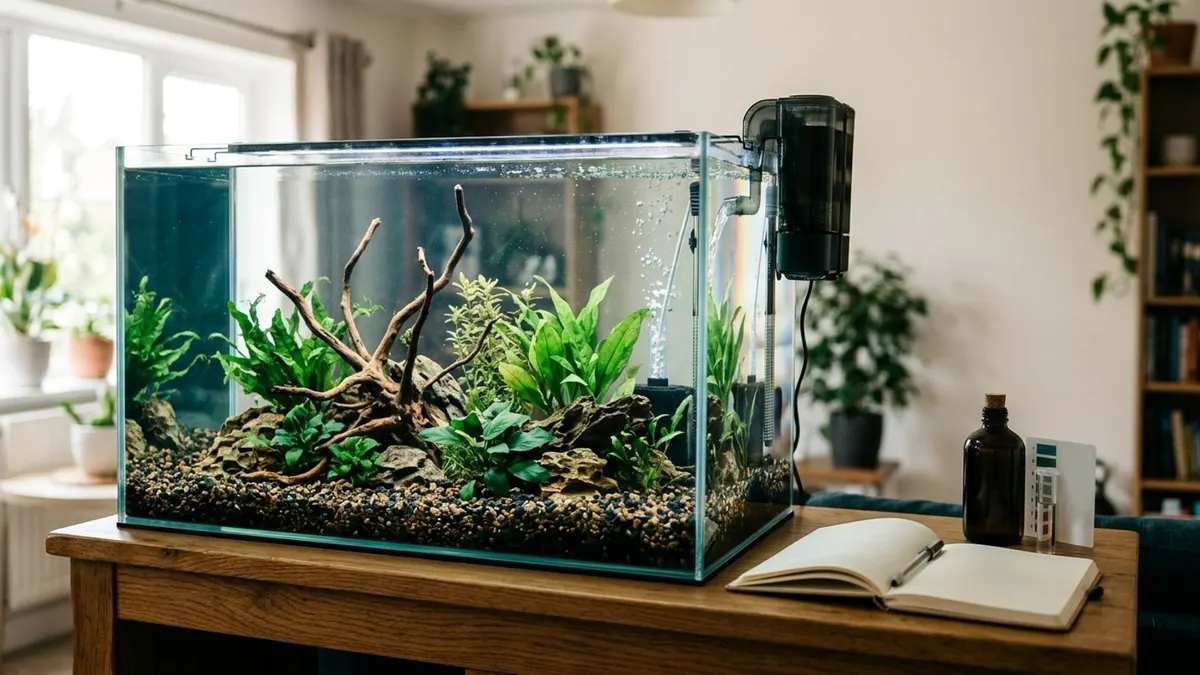
Cover image: Illustration: Aquarium Gear Review (AI-generated)
Related guides
API Freshwater Master Test Kit Review: Every Test, Step by Step
The API Freshwater Master Test Kit is still the kit to beat for freshwater tanks. Here is what each of its five tests measures, how to run them correctly, and its limits.
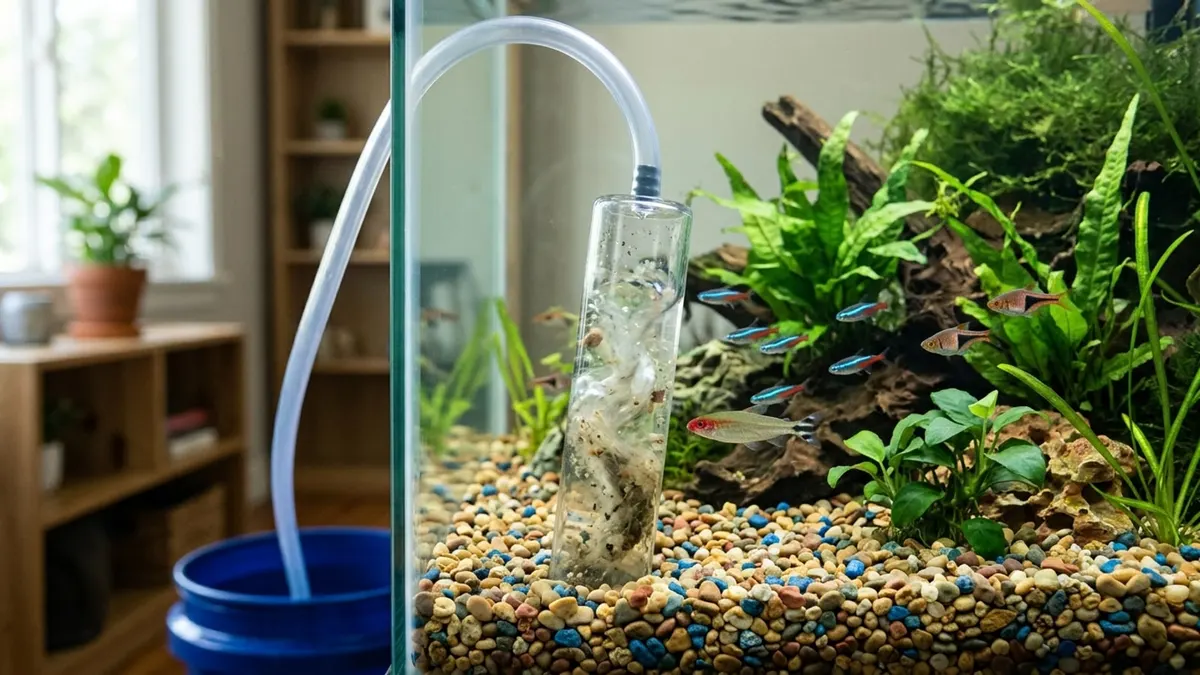
Best Aquarium Gravel Vacuums and Water Changers (2026)
For tanks of 20 gallons and up, the Python No Spill Clean and Fill ends bucket carrying. For smaller tanks, Aqueon's bulb siphon is all you need. Here are both and an electric option.
Best Aquarium Water Conditioners (2026): Doses and Claims Compared
Seachem Prime is the water conditioner we would buy: 5 mL treats 50 gallons, it handles chloramine, and Seachem states exactly what its ammonia binding does and does not do.