
Best Aquarium Water Test Kits (2026): Liquid Kits vs Strips
The best aquarium water test kits for freshwater and saltwater, compared on what each measures, ranges, test count, accuracy method, and liquid kits versus strips.
Affiliate disclosure: product links on this page go to Amazon or to the maker's own store. As an Amazon Associate we earn from qualifying purchases, at no extra cost to you; links to makers' stores earn us nothing. No retailer or brand sees our picks before they are published or has any say in them. How we choose.
The API Freshwater Master Test Kit is the aquarium water test kit we would buy. It measures the five things that matter in a freshwater tank: pH (6.0 to 7.6), high-range pH (7.4 to 8.8), ammonia (0 to 8 ppm), nitrite (0 to 5 ppm) and nitrate (0 to 160 ppm), with over 800 tests in seven bottles. Its ammonia test uses the salicylate method, which University of Florida extension scientists note is not thrown off by ammonia-binding water conditioners the way older Nessler kits are.
Strips are faster and fine for weekly checks once a tank is established; a liquid kit is the one to trust while cycling a new tank or when fish look unwell. Here are the best of each, plus a kit for saltwater.
Our top picks at a glance
1. Best overall (freshwater)
API Freshwater Master Test Kit (800+ tests)Measures: pH, high-range pH, ammonia, nitrite, nitrate · Tests: Over 800 (7 bottles, 4 tubes) · Type: Liquid reagent, salicylate ammonia · Water: Freshwater only
2. Best for saltwater (fish-only)
API Saltwater Master Test Kit (550 tests)Measures: High-range pH, ammonia, nitrite, nitrate · Tests: 550 (6 bottles, 4 tubes) · Type: Liquid reagent · Water: Saltwater
3. Best strips
Tetra EasyStrips 6-in-1, 25 stripsMeasures: Nitrate, nitrite, hardness, chlorine, alkalinity, pH · Tests: 25 strips · Type: Dip strip, 60 seconds · Water: Fresh or salt; hardness pad freshwater only (Tetra)
4. Best value strips
API 5-in-1 Test Strips, 100 stripsMeasures: pH, nitrite, nitrate, KH, GH · Tests: 100 strips · Type: Dip strip · Water: Freshwater or saltwater (API)
| Pick | Measures | Tests | Type | Water | Buy |
|---|---|---|---|---|---|
| API Freshwater Master Test Kit (800+ tests)Best overall (freshwater) | pH, high-range pH, ammonia, nitrite, nitrate | Over 800 (7 bottles, 4 tubes) | Liquid reagent, salicylate ammonia | Freshwater only | Amazon |
| API Saltwater Master Test Kit (550 tests)Best for saltwater (fish-only) | High-range pH, ammonia, nitrite, nitrate | 550 (6 bottles, 4 tubes) | Liquid reagent | Saltwater | Amazon |
| Tetra EasyStrips 6-in-1, 25 stripsBest strips | Nitrate, nitrite, hardness, chlorine, alkalinity, pH | 25 strips | Dip strip, 60 seconds | Fresh or salt; hardness pad freshwater only (Tetra) | Amazon |
| API 5-in-1 Test Strips, 100 stripsBest value strips | pH, nitrite, nitrate, KH, GH | 100 strips | Dip strip | Freshwater or saltwater (API) | Amazon |
Best overall (freshwater)
API Freshwater Master Test Kit (800+ tests)
Five liquid tests covering the nitrogen cycle and pH, over 800 tests, with clear printed instructions and ranges.
- Measures
- pH, high-range pH, ammonia, nitrite, nitrate
- Tests
- Over 800 (7 bottles, 4 tubes)
- Type
- Liquid reagent, salicylate ammonia
- Water
- Freshwater only
Pros
- Ammonia 0 to 8 ppm, nitrite 0 to 5 ppm, nitrate 0 to 160 ppm (API instructions)
- Salicylate ammonia test, which UF/IFAS says is unaffected by ammonia binders
- Over 800 tests for far less per test than strips
Cons
- Takes several minutes per test; the nitrate test needs careful shaking
- No GH or KH test in this kit
API's instruction booklet sets out each test: 5 mL of tank water in a tube, then 8 and 8 drops for ammonia (shake 5 seconds, wait 5 minutes), 5 drops for nitrite (shake 5 seconds, wait 5 minutes), 3 drops for pH, 5 drops for high-range pH, and 10 and 10 drops for nitrate, with bottle #2 shaken for at least 30 seconds and the tube for a full minute. API calls those shaking steps extremely important to accuracy, and most odd nitrate readings trace back to skipping them.
API recommends testing nitrite every other day when a tank is first set up and weekly once the biological filter is established, which it puts at about 4 to 6 weeks. It recommends 40 ppm nitrate or less for freshwater aquariums. Our full review goes through every test.
Best for saltwater (fish-only)
API Saltwater Master Test Kit (550 tests)
The marine version: high-range pH, ammonia, nitrite and nitrate in 550 tests, sold by Amazon.
- Measures
- High-range pH, ammonia, nitrite, nitrate
- Tests
- 550 (6 bottles, 4 tubes)
- Type
- Liquid reagent
- Water
- Saltwater
Pros
- Covers the nitrogen cycle in marine water
- Sold by Amazon.com
- Same simple tube-and-chart method as the freshwater kit
Cons
- Does not test calcium, alkalinity or magnesium, which reef tanks need
- Not as precise at low nitrate as dedicated reef kits
API says its Saltwater Master Test Kit holds six bottles of liquid reagent, four test tubes with snap-tight caps and a holding tray, and measures high-range pH, ammonia, nitrite and nitrate; the listing puts it at 550 tests. That covers cycling and routine checks on a fish-only marine tank.
Reef tanks need more: calcium, alkalinity (KH) and magnesium for coral growth, and very low nitrate and phosphate. API's Reef Master kit or individual reef kits fill that gap.
API's own FAQ says the Saltwater Master kit can be used in a tank with corals, but recommends the Reef Master Test Kit there for best results. The Reef Master tests calcium, carbonate hardness (KH), phosphate and nitrate, the levels API says corals and reef invertebrates depend on.
Best strips
Tetra EasyStrips 6-in-1, 25 strips
Six readings on one strip in 60 seconds, including chlorine, for quick weekly checks.
- Measures
- Nitrate, nitrite, hardness, chlorine, alkalinity, pH
- Tests
- 25 strips
- Type
- Dip strip, 60 seconds
- Water
- Fresh or salt; hardness pad freshwater only (Tetra)
Pros
- Chlorine pad confirms your conditioner worked
- Results in 60 seconds
- Sold by Amazon.com
Cons
- No ammonia pad, so it cannot track a new tank's cycle on its own
- Strips cost more per test than a liquid kit
Tetra's EasyStrips read nitrate, nitrite, hardness, chlorine, alkalinity and pH on one strip: dip, wait 60 seconds and compare, according to the listing. The chlorine pad is handy right after a water change.
Strips have no ammonia test here, and ammonia is the first thing to rise in a new tank, so pair them with a liquid ammonia test while cycling. For an established tank, a weekly strip is a fast way to spot nitrate creeping up.
Tetra's directions are short: dip the strip for one second, do not shake off the excess, hold it level for 60 seconds, then compare. Keep the cap tight and leave the drying agent in the bottle, since moisture spoils the pads; Tetra prints a use-by date on the bottom of the bottle. Its notes put nitrite below 0.5 ppm, freshwater alkalinity at 120 to 300 ppm, and say the pH pad reads accurately only when alkalinity is at least 120 ppm.
Best value strips
API 5-in-1 Test Strips, 100 strips
pH, nitrite, nitrate, KH and GH on 100 strips, sold by Amazon.
- Measures
- pH, nitrite, nitrate, KH, GH
- Tests
- 100 strips
- Type
- Dip strip
- Water
- Freshwater or saltwater (API)
Pros
- Adds GH and KH, which the liquid master kit lacks
- 100 strips in a box
- Sold by Amazon.com
Cons
- No ammonia
- Color judgment is coarser than a liquid test
API's 5-in-1 strips check pH, nitrite, nitrate, carbonate hardness (KH) and general hardness (GH), according to the listing. KH matters more than most beginners know: UF/IFAS notes that nitrifying bacteria use alkalinity and cannot function if it falls below 20 mg/L. A strip that shows KH dropping is an early warning.
API's directions differ from Tetra's in timing. Dip the strip and swirl it twice, lift it out flat with the pads facing up and without shaking it, read GH and KH straight away, then wait 30 seconds before reading pH, nitrite and nitrate. Read in good light and keep wet fingers out of the tube.
What to test, and why
| Test | Why it matters | Target (source) |
|---|---|---|
| Ammonia | Fish waste; toxic even in small amounts | 0 in an established tank (API, UF/IFAS) |
| Nitrite | The middle step of the cycle; also toxic | 0; UF/IFAS says toxic from 0.10 mg/L |
| Nitrate | End product; builds up between water changes | 40 ppm or less in freshwater (API) |
| pH | Acidity; affects how toxic ammonia is | Depends on species (API lists 7.0 for a community tank) |
| KH (alkalinity) | Buffers pH; feeds nitrifying bacteria | Above 20 mg/L for the bacteria (UF/IFAS) |
University of Florida extension scientists explain why pH matters for ammonia: ammonia exists in two forms, and the un-ionized form, which is far more toxic, makes up more of the total at high temperature and high pH. That is why a reading of ammonia in an alkaline African cichlid tank is more urgent than the same reading in a soft, acidic tank.
Owning a test kit beats relying on the fish shop. Merck's veterinary manual says many pet stores have very limited water-testing capabilities, use less accurate tests and may be unable to interpret the results. UF/IFAS adds that a good ammonia test kit includes a total ammonia test, a pH test and a thermometer, because pH and temperature decide how much of the ammonia is in the toxic form.
Which API kit covers which tank
API's test kit range splits by tank type, and its product pages and instructions list what each one measures:
| API kit | Measures | Format | For |
|---|---|---|---|
| Freshwater Master Test Kit | pH, high-range pH, ammonia, nitrite, nitrate | 7 liquid reagents | Freshwater |
| Saltwater Master Test Kit | High-range pH, ammonia, nitrite, nitrate | 6 liquid reagents | Fish-only marine |
| Reef Master Test Kit | Calcium, KH, phosphate, nitrate | Liquid reagents | Reef tanks |
| GH and KH Test Kit | General and carbonate hardness | 2 liquid reagents | Freshwater |
| 5-in-1 Test Strips | pH, nitrite, nitrate, GH, KH | Dip strips | Fresh or salt |
For the full freshwater picture, pair the Freshwater Master kit with the GH and KH kit or the 5-in-1 strips. API says low KH can lead to rapid, wide pH swings that stress fish, and the master kit does not measure it.
Reading the units: ppm, mg/L and nitrate-nitrogen
Aquarium test kit units matter when you compare a reading with a published limit. API's booklet says its kit reports total nitrite (NO2) and total nitrate (NO3) in parts per million, which equal milligrams per liter. Merck's veterinary manual notes that most test kits report nitrite-nitrogen or nitrate-nitrogen instead, and gives the conversions: multiply nitrite-nitrogen by 3.3, and nitrate-nitrogen by 4.4. Check which one your kit's chart uses before comparing it with a target.
Liquid kit or strips?
| Liquid kit | Strips | |
|---|---|---|
| Accuracy | Finer color steps | Coarser |
| Speed | About 5 minutes per test | About 1 minute for all |
| Cost per test | Low (800+ tests) | Higher |
| Ammonia | Yes (API) | Not on the two strips here |
| Best for | Cycling, troubleshooting | Weekly checks on an established tank |
How we chose
- What it measures. Ammonia, nitrite and nitrate first.
- Method. Salicylate ammonia tests read correctly with ammonia-binding conditioners; UF/IFAS warns that Nessler tests give false high readings after binders and contain mercury.
- Published ranges and steps from the maker's instructions.
- Cost per test and stock on Amazon US.
How often to test
- New tank: ammonia and nitrite every other day until both read zero; see how to cycle a fish tank.
- Established tank: weekly, as API and PetMD suggest, and before water changes.
- When fish look wrong: test first. UF/IFAS notes that ammonia is colorless and odorless, so testing is the only way to know.
What to do with high readings
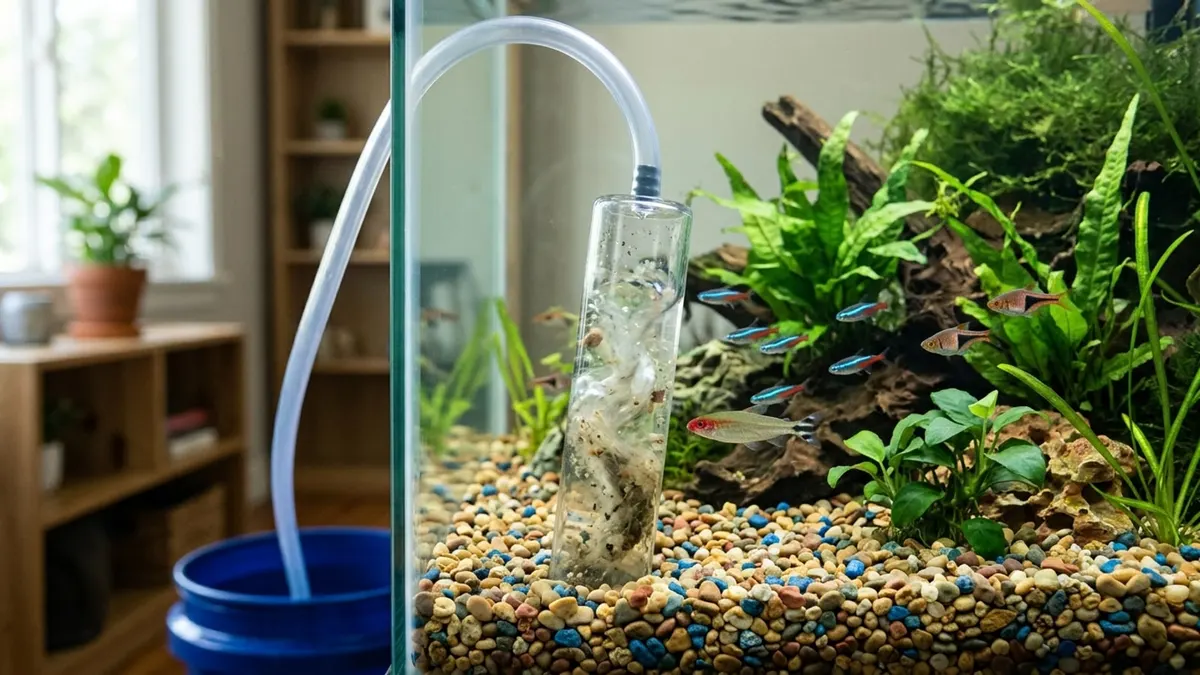
For ammonia or nitrite, UF/IFAS advises reducing or stopping feeding and, in tanks small enough, a 25 to 50 percent water change; ammonia-binding conditioners help in the short term. Use a conditioner that states it binds ammonia, and a gravel vacuum to make water changes quick. For nitrate above 40 ppm, change water more often and check whether your tap water already contains nitrate (API notes many supplies do), in which case RO water helps.
Frequently asked questions
What is the best aquarium test kit?
For freshwater, the API Freshwater Master Test Kit. It tests pH, high-range pH, ammonia (0 to 8 ppm), nitrite (0 to 5 ppm) and nitrate (0 to 160 ppm) with over 800 tests.
Are aquarium test strips accurate?
They are good enough for weekly checks on an established tank, but their color steps are coarser than liquid kits. The two strip kits we recommend do not test ammonia, so use a liquid kit while cycling.
What should ammonia be in a fish tank?
Zero in an established tank. University of Florida extension scientists say any ammonia means the system is out of balance and that the toxic un-ionized form harms fish from 0.05 mg/L.
What is a safe nitrate level for a freshwater aquarium?
API recommends 40 ppm or less for freshwater aquariums and as low as possible in marine tanks, especially with invertebrates.
How often should I test my aquarium water?
Every other day for ammonia and nitrite while a new tank cycles, then weekly once the filter is established, as API recommends. Test any time fish look unwell.
Why does my ammonia test read high after using a water conditioner?
Older Nessler-type ammonia tests read falsely high after ammonia-binding conditioners, as UF/IFAS and Seachem both note. Salicylate tests, such as API's, are not affected the same way.
Sources
- Freshwater Master Test Kit instructions, API (Mars Fishcare)
- FA16 Ammonia in Aquatic Systems (Francis-Floyd, Watson, Petty and Pouder), University of Florida IFAS Extension
- Prime, Seachem
- Betta Fish Care Sheet (Maria Zayas, DVM), PetMD
- API Saltwater Master Test Kit, API (Mars Fishcare)
- API Reef Master Test Kit, API (Mars Fishcare)
- API General & Carbonate Hardness Test Kit, API (Mars Fishcare)
- API 5-in-1 Test Strips, API (Mars Fishcare)
- EasyStrips 6-in-1 Aquarium Test Strips, Tetra
- Environmental Diseases of Aquatic Animals in Aquatic Systems (Francis-Floyd, Yanong and Petty), Merck Veterinary Manual
Cover photo: U.S. Department Agriculture, Agricultural Marketing by U.S. Department of Agriculture, CC0 1.0, via rawpixel. Cropped.
Related guides
API Freshwater Master Test Kit Review: Every Test, Step by Step
The API Freshwater Master Test Kit is still the kit to beat for freshwater tanks. Here is what each of its five tests measures, how to run them correctly, and its limits.
Best Aquarium Gravel Vacuums and Water Changers (2026)
For tanks of 20 gallons and up, the Python No Spill Clean and Fill ends bucket carrying. For smaller tanks, Aqueon's bulb siphon is all you need. Here are both and an electric option.
Best Aquarium Water Conditioners (2026): Doses and Claims Compared
Seachem Prime is the water conditioner we would buy: 5 mL treats 50 gallons, it handles chloramine, and Seachem states exactly what its ammonia binding does and does not do.