
Aquarium Filter Media Explained: What Goes in Each Stage and in What Order
Aquarium filter media explained: mechanical, biological and chemical stages, the right order, how often to rinse or replace each one, and the media worth buying.
Affiliate disclosure: product links on this page go to Amazon or to the maker's own store. As an Amazon Associate we earn from qualifying purchases, at no extra cost to you; links to makers' stores earn us nothing. No retailer or brand sees our picks before they are published or has any say in them. How we choose.
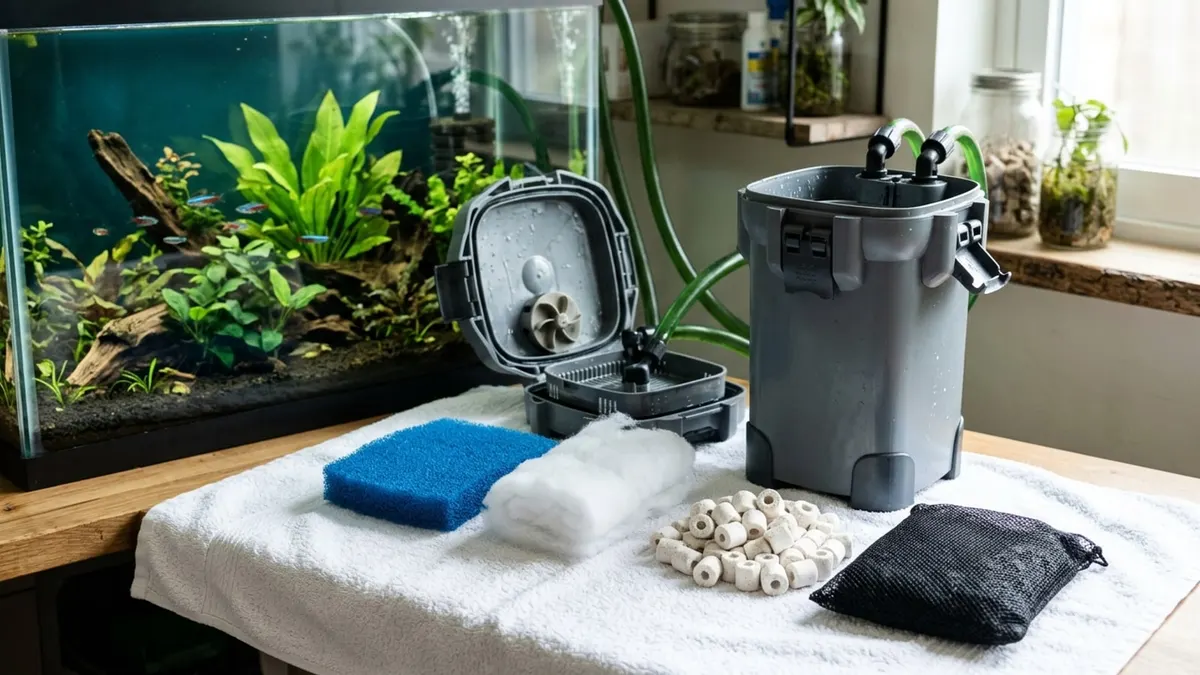
Filter media goes in three stages, in this order: coarse foam to catch debris, porous biomedia for bacteria, and then (optional) fine floss and chemical media such as carbon. The foam protects the biomedia from clogging, the biomedia does the work that keeps fish alive, and the chemical stage polishes the water. Rinse the first two in old tank water; replace only the floss and the chemicals.
That is the whole system. Below is what each kind of media does, how much to use where the maker says, and the mistakes that crash a tank's cycle.
The three jobs of filter media
| Stage | Media | What it does | Maintenance |
|---|---|---|---|
| Mechanical | Coarse foam, sponge, pre-filter | Traps fish waste, food and plant debris before it reaches the biomedia | Rinse in tank water when flow drops |
| Biological | Ceramic rings, porous stone (BIOMAX, Matrix), foam | Houses the bacteria that convert ammonia and nitrite | Rinse gently in tank water; rarely or never replace |
| Fine mechanical | Filter floss, polishing pad | Strains fine particles for clear water | Replace when brown and clogged |
| Chemical | Activated carbon, Purigen, zeolite, phosphate pads | Removes color, odor, medications and some dissolved waste | Replace or regenerate when spent |
Biological media: the stage that matters most
Fish excrete ammonia, which is toxic. University of Florida extension scientists describe how bacteria including Nitrosomonas convert ammonia to nitrite and others including Nitrobacter and Nitrospira convert nitrite to nitrate, the far less toxic end product. In a tank, they write, a biological filter has to give those bacteria a place to live, and a new one takes six to eight weeks to build up. They also note that both groups of bacteria need oxygen, which is why a filter should never be switched off for long.
Biomedia is any surface with a lot of area for bacteria. Porous ceramic and stone media pack the most area into the least space. Seachem says each liter of its Matrix provides more than about 700 square meters of surface, with pores sized for nitrifying bacteria, and recommends 250 mL for each 200 liters (50 US gallons) of water. Fluval's BIOMAX is a ceramic ring that comes with Fluval's canisters and AC filters.
Because most of the bacteria live inside the pores, Seachem says Matrix can be rinsed when needed without harming the filter, and that it does not wear out. The same applies to most ceramic media: rinse it in a bucket of tank water if it clogs, and keep it for years.
Mechanical media: protect the biomedia
Coarse foam goes first, where the water enters. It catches the big debris so the biomedia does not clog. Fluval's 07 series canisters use a vertical pre-filter and several foams for this, and its AC hang-on-back filters lead with a foam block and an intake sponge. Rinse foam in tank water whenever the filter's flow slows. Foam also grows bacteria, so never replace all of it at once.
Fine floss is the last mechanical stage, after the biomedia, where it polishes out fine particles. It clogs fast and is cheap, so replace it rather than rinse it.
Chemical media: useful, not required
A healthy, well-maintained tank does not need chemical media. It earns its place for specific jobs:
- Activated carbon removes tannins (yellow-brown water from driftwood), odors and leftover medication after a course of treatment. It saturates and must be replaced. Remove it while dosing medication, or it will absorb the treatment.
- Seachem Purigen is a synthetic resin. Seachem says it controls ammonia, nitrite and nitrate by removing the nitrogenous organic waste that would otherwise release them, and that each 250 mL treats up to 1,000 liters (250 US gallons) for up to six months. It starts pale and turns dark brown or black when exhausted, and Seachem gives a bleach regeneration method so it can be reused.
- Zeolite (ammonia remover) absorbs ammonia in freshwater, useful in an emergency. Fluval sells it as Zeo-Carb and Ammonia Remover.
- Phosphate pads and resins help in tanks battling algae driven by phosphate.
The order, filter by filter
Canister filters
Water usually enters at the bottom and rises. Put coarse foam in the lowest tray, biomedia in the middle trays, and fine floss or chemical media at the top. Fluval's 07 series has up to eight chambers and a vertical pre-filter, and ships with Bio-Foam Max, Bio-Foam, Bio-Foam+, carbon, BIOMAX and Quick-Clear pads in counts that vary by model. Check your filter's manual for the flow direction. Our best canister filters guide covers the filters themselves.
Hang-on-back filters
In a box-style HOB such as Fluval's AC series, water rises through the box from the bottom, so the foam goes lowest and the biomedia sits above it; follow the manual for where the carbon insert goes. Cartridge HOBs combine floss and carbon in one cartridge; add a sponge or a bag of ceramic media if the box has room, so the bacteria survive cartridge changes. See the best hang-on-back filters.
Sponge filters
The sponge is the mechanical and biological media in one. There is nothing to replace; squeeze it in tank water every few weeks. Our sponge filter guide covers sizes.
How to clean media without losing the cycle
- Siphon a bucket of water out of the tank during your water change.
- Unplug the filter. Lift out the media.
- Swish and squeeze the foam in the bucket until it runs mostly clear. Do not aim for spotless.
- Swirl the biomedia in the same water only if it is visibly clogged.
- Replace floss and spent carbon.
- Reassemble, prime and restart the filter promptly so the bacteria get oxygen again.
Never rinse foam or biomedia under the tap. Water utilities disinfect tap water with chlorine or chloramine (the EPA explains why), and those disinfectants kill bacteria. If you must use tap water, treat it with a water conditioner first.
Common mistakes
- Replacing all the media at once. It throws out the bacteria and can cause an ammonia spike. Fluval's CycleGuard design exists to stop exactly this.
- Swapping biomedia for carbon. Carbon is chemical media; it is not a home for bacteria in any useful amount.
- Running carbon while medicating. It absorbs the medication.
- Using generic media that leaves gaps. Fluval warns that media that does not fit can let water bypass the filter and may affect warranty coverage.
A test kit is how you know the biological stage is working: ammonia and nitrite at zero, nitrate present. If you are setting up a new tank, read how to cycle a fish tank before you add fish.
Frequently asked questions
What order should filter media go in?
Coarse mechanical foam first, where water enters, then biological media, then fine floss and any chemical media last. The foam keeps the biomedia from clogging, and the floss polishes the water on its way out.
How often should I replace aquarium filter media?
Rarely, for foam and ceramic biomedia: rinse them in tank water instead. Replace fine floss when it is brown and clogged, carbon when it stops clearing color or odor, and resins such as Purigen when they turn dark brown or black.
Do I need activated carbon in my aquarium filter?
No. Carbon is optional chemical filtration, useful for removing tannins, odors and leftover medication. A healthy tank with regular water changes runs well without it.
Can I clean filter media with tap water?
Not foam or biomedia. Tap water carries chlorine or chloramine disinfectants that kill the filter's bacteria. Rinse those in a bucket of water taken from the tank.
How much biomedia do I need?
Follow the media maker. Seachem recommends 250 mL of Matrix for each 200 liters (50 US gallons) of water, noting the dose may differ from the package. More biomedia is never harmful if the filter has room.
What does Seachem Purigen do?
Seachem says Purigen removes soluble and insoluble organic impurities and controls ammonia, nitrite and nitrate by removing the organic waste that releases them. Each 250 mL treats up to 250 US gallons for up to six months.
Sources
- Matrix, Seachem
- Purigen, Seachem
- 07 Series Aquarium Filters, Fluval
- AC Series Aquarium Filters, Fluval
- FA16 Ammonia in Aquatic Systems (Francis-Floyd, Watson, Petty and Pouder), University of Florida IFAS Extension
- Chloramines in Drinking Water, US EPA
Cover image: Illustration: Aquarium Gear Review (AI-generated)
Related guides
Best Aquarium Air Pumps: Quiet, Adjustable and Battery Backup
Tetra's Whisper is the air pump most tanks need. Here are the quiet, adjustable, nano and battery-backup alternatives, and how to size one to your tank and sponge filter.
Best Aquarium Filters by Tank Size (2026): HOB, Canister and Sponge
Which filter type fits your tank, and the one we would buy at each size: a sponge for bettas and shrimp, Fluval's AC30 up to 30 gallons, the 307 canister for 40 to 70, and the FX4 above that.
Best Aquarium UV Sterilizers for Green Water and Free-Floating Pests
Coralife's Turbo-Twist 3X is the UV sterilizer most tanks under 125 gallons should start with. Here is what UV does, what it does not, and which type fits your filter.