
Best Aquarium Gravel Vacuums and Water Changers (2026)
The best aquarium gravel vacuums and water changers, from bucket siphons to the Python faucet system and an electric cleaner, compared on fit and setup.
Affiliate disclosure: product links on this page go to Amazon or to the maker's own store. As an Amazon Associate we earn from qualifying purchases, at no extra cost to you; links to makers' stores earn us nothing. No retailer or brand sees our picks before they are published or has any say in them. How we choose.
For a tank of 20 gallons or more within reach of a sink, the Python No Spill Clean and Fill is the gravel vacuum we would buy. It uses your faucet's running water to pull a siphon, so you drain the tank straight down the sink, then flip a switch and refill from the same hose: no buckets. For tanks of 15 to 55 gallons without a nearby sink, Aqueon's bulb-start siphon is the simple choice.
Gravel vacuuming and water changes are the single most effective maintenance a tank gets. Veterinarian Maria Zayas suggests changing 15 to 25 percent of a betta tank's water weekly on PetMD, and the RSPCA's aquarium vet recommends weekly 10 to 25 percent changes combined with gravel cleaning. The right tool makes that a ten-minute job.
Our top picks at a glance
1. Best overall (20 gallons and up)
Python No Spill Clean and Fill, 25 ftType: Faucet-driven drain and fill · Tank size: Any; choose the hose length for the distance to the sink · How it starts: Running faucet creates suction · Includes: 25 ft hose, gravel tube, switch, faucet pump, brass adapter
2. Best bucket siphon (15 to 55 gallons)
Aqueon Siphon Gravel Cleaner with Bulb, Large (10 in)Type: Manual siphon with priming bulb · Tank size: 15 to 55 gal (Aqueon) · How it starts: Squeeze bulb or pump up and down · Includes: 6 ft hose, bulb, intake tube, hose clip
3. Best for small tanks
Aqueon Siphon Gravel Cleaner, Mini (5 in)Type: Manual siphon · Tank size: 1 to 5 gal (Aqueon) · How it starts: Pump up and down · Includes: Tube and hose
4. Best electric
hygger 360 GPH Electric Gravel CleanerType: Electric pump, 15 W · Tank size: Tubes extend 11.4 to 40.5 in (per the listing) · How it starts: Switch on · Includes: Pump, 4 tubes, sand and gravel heads, brush, filter housing
| Pick | Type | Tank size | How it starts | Includes | Buy |
|---|---|---|---|---|---|
| Python No Spill Clean and Fill, 25 ftBest overall (20 gallons and up) | Faucet-driven drain and fill | Any; choose the hose length for the distance to the sink | Running faucet creates suction | 25 ft hose, gravel tube, switch, faucet pump, brass adapter | Amazon |
| Aqueon Siphon Gravel Cleaner with Bulb, Large (10 in)Best bucket siphon (15 to 55 gallons) | Manual siphon with priming bulb | 15 to 55 gal (Aqueon) | Squeeze bulb or pump up and down | 6 ft hose, bulb, intake tube, hose clip | Amazon |
| Aqueon Siphon Gravel Cleaner, Mini (5 in)Best for small tanks | Manual siphon | 1 to 5 gal (Aqueon) | Pump up and down | Tube and hose | Amazon |
| hygger 360 GPH Electric Gravel CleanerBest electric | Electric pump, 15 W | Tubes extend 11.4 to 40.5 in (per the listing) | Switch on | Pump, 4 tubes, sand and gravel heads, brush, filter housing | Amazon |
Best overall (20 gallons and up)
Python No Spill Clean and Fill, 25 ft
Drains to the sink and refills from the tap through one hose, so water changes need no buckets at all.
- Type
- Faucet-driven drain and fill
- Tank size
- Any; choose the hose length for the distance to the sink
- How it starts
- Running faucet creates suction
- Includes
- 25 ft hose, gravel tube, switch, faucet pump, brass adapter
Pros
- No buckets: drain to the sink, refill from the tap
- Gravel tube vacuums debris while draining
- Sold by Amazon.com in 25 and 50 foot lengths
Cons
- Draining uses running tap water to power the suction
- Refilling straight from the tap means dosing conditioner for the whole tank volume and matching temperature at the faucet
The Python attaches to a faucet with its brass adapter and faucet pump. Running water through the pump creates suction that pulls tank water down the hose and into the sink, while the gravel tube lifts debris from the substrate. Flip the switch and the same hose refills the tank from the tap. The listing says it comes with the hose, gravel tube, switch, connectors, faucet pump and brass adapter, for freshwater and saltwater tanks of any size.
When refilling from the tap, set the temperature at the faucet with a thermometer in a cup, and add water conditioner for the full tank volume before you start, since you cannot treat a bucket. Seachem Prime's dose is 5 mL per 50 gallons.
Best bucket siphon (15 to 55 gallons)
Aqueon Siphon Gravel Cleaner with Bulb, Large (10 in)
A 10 inch gravel tube with a priming bulb and a bucket clip, sold by Amazon for very little.
- Type
- Manual siphon with priming bulb
- Tank size
- 15 to 55 gal (Aqueon)
- How it starts
- Squeeze bulb or pump up and down
- Includes
- 6 ft hose, bulb, intake tube, hose clip
Pros
- Bulb starts the siphon without mouth-priming
- Clip holds the hose in the bucket
- Sold by Amazon.com
Cons
- 6 ft hose: you carry buckets
- 90-day warranty (Aqueon)
Aqueon's large siphon has a 10 inch intake tube, a 6 foot flexible hose, a priming bulb and a clip that holds the hose inside a bucket, and Aqueon rates it for tanks of 15 to 55 gallons. Squeeze the bulb or pump the tube up and down to start the flow, then push the tube into the gravel and lift so debris rises while the gravel falls back.
Keep one bucket only for the aquarium, and never use soap in it.
Best for small tanks
Aqueon Siphon Gravel Cleaner, Mini (5 in)
A 5 inch tube for betta and nano tanks, where a big siphon would empty the tank in seconds.
- Type
- Manual siphon
- Tank size
- 1 to 5 gal (Aqueon)
- How it starts
- Pump up and down
- Includes
- Tube and hose
Pros
- Short tube fits a 5 gallon tank
- Slow enough flow to stop before draining too much
- Sold by Amazon.com
Cons
- Small tube cleans a little at a time
- No priming bulb
In a 5 gallon tank, a 25 percent change is barely more than a gallon. Aqueon's mini siphon has a 5 inch tube sized for small tanks, which keeps the flow slow enough to control. Pair it with a measuring jug so you know how much you have taken out.
Aqueon rates the 5 inch mini for tanks of 1 to 5 gallons. A 10 gallon betta tank sits just past that, so for one, Aqueon's medium 5 inch siphon, rated for 5 to 20 gallons, fits better.
Best electric
hygger 360 GPH Electric Gravel Cleaner
A 360 GPH electric pump with extension tubes and heads, for tall tanks or keepers who cannot start a siphon.
- Type
- Electric pump, 15 W
- Tank size
- Tubes extend 11.4 to 40.5 in (per the listing)
- How it starts
- Switch on
- Includes
- Pump, 4 tubes, sand and gravel heads, brush, filter housing
Pros
- No siphon to start; up to 360 GPH with a 4.92 ft head (per the listing)
- Filter-only mode returns clean water to the tank
- UL-certified power supply, 2-year warranty (per the listing)
Cons
- Electrical device in water: plug into a GFCI outlet and keep the adapter dry
- More parts to rinse and store
hygger's electric cleaner uses a 15 W pump rated up to 360 gallons per hour, with four rigid tubes that extend from 11.4 to 40.5 inches, several heads for sand and gravel, a brush, and a filter housing that lets it clean without removing water, according to its listing. The listing gives a 4.92 foot head and a UL-certified power supply.
It suits tall tanks and anyone who struggles to start a siphon. As with any pump, keep the power supply out of splash range and on a GFCI-protected outlet.
How we chose
- Fit to tank size. A tube long enough to reach the bottom, and a flow you can control.
- How it starts. Bulbs, faucet suction and electric pumps beat mouth-priming.
- Buckets or not. For 20 gallons and up, the faucet system saves the most effort.
- Stock and seller on Amazon US on November 8, 2026.
Which siphon size fits your tank
Aqueon makes its siphon gravel vacuum in five sizes, every one with a 6 foot hose, and rates each for a band of tank sizes:
| Aqueon model | Tube length | Rated tank size | Starts with |
|---|---|---|---|
| Mini | 5 in | 1 to 5 gal | Up and down motion |
| Medium | 5 in | 5 to 20 gal | Up and down motion |
| Medium | 9 in | 15 to 35 gal | Up and down motion |
| Large with bulb | 10 in | 15 to 55 gal | Priming bulb |
| Large | 16 in | 40 gal and larger | Up and down motion |
Match the tube to the tank's depth as well as its gallons. A tube much shorter than the tank is deep puts your forearm in the water, and a long, wide tube in a nano tank pulls water out faster than you can control. Aqueon lists a 90-day warranty on the line.
How to vacuum gravel
- Unplug the heater and filter (a heater left running in air can crack).
- Start the siphon and push the tube into the gravel. Let debris rise, then lift and move on before the gravel climbs too high.
- Work in sections. In a heavily planted tank, hover over the surface instead of digging around roots.
- Stop when you have removed the amount you planned, usually 10 to 25 percent, as the veterinary sources above suggest.
- Refill with temperature-matched, conditioned water. Restart the filter and heater.
Sand needs a lighter touch
Sand is light enough to be sucked up. Hold the tube just above the surface and let the flow lift waste off the top, or pinch the hose to slow it.
Setting up and troubleshooting the Python
The Python No Spill Clean and Fill connects to a sink faucet once the aerator is unscrewed. Python Products says its 69HD brass adapter fits faucets with inside (female) threads as supplied; for outside (male) threads, take out the large white washer first. Python sells separate adapters (MABA and FEBA) for the few faucets the brass one does not fit, including some newer faucets with smaller threads.
If the Python will not drain, Python's FAQ lists the usual causes: a loose fitting, cold water not turned on full force, the pump not set to the drain position, or a pump top not screwed all the way onto the adapter. For the refill, Python suggests pouring your conditioner into the return stream as the tank fills.
Why water changes matter
The filter's bacteria turn ammonia into nitrate, but nitrate builds up until you remove it. API recommends keeping freshwater nitrate at 40 ppm or less, and the simplest way to do that is regular water changes. University of Florida extension scientists also recommend a 25 to 50 percent water change as a first step when ammonia appears in a small tank. A test kit tells you whether your schedule is keeping up. Water changes also do not disturb the filter's bacteria, which live in the filter and on surfaces; see our filter media guide for cleaning the filter itself.
A good filter does not change that. Seachem's filtration primer, by Leo G. Morin, PhD, states that no system exists that can replace water changes, because they remove wastes the filter leaves behind and restore the water's mineral balance.
How much water to change
Advice on gravel vacuum water changes varies by source. Python's own FAQ recommends only 5 to 10 percent every other week and warns that taking out too much at once can stress fish; the veterinary sources above suggest 10 to 25 percent weekly. Let your nitrate test decide: if nitrate climbs past API's 40 ppm between changes, change more water or change it more often.
Check your tap water before a big change in a new tank. Merck's veterinary manual notes that when chloramine-treated water is dechlorinated, the ammonia in it is released, so repeated large changes can raise ammonia that an immature filter cannot yet handle. A conditioner that also binds ammonia covers that gap.
What to skip
- Changing all the water at once. It shocks fish with new chemistry and temperature.
- Soap in aquarium buckets.
- Refilling with cold tap water in a small tank; match the temperature with a thermometer. For betta tanks, see betta water temperature.
Going away between water changes? An automatic fish feeder with fixed portions keeps feeding steady without overfeeding.
Frequently asked questions
How do you use an aquarium gravel vacuum?
Start the siphon, push the tube into the gravel so debris rises, then lift and move to the next section before the gravel climbs too high. Stop once you have removed 10 to 25 percent of the water and refill with conditioned, temperature-matched water.
How often should I vacuum my fish tank gravel?
With each water change, which many keepers do weekly. The RSPCA's aquarium vet recommends weekly 10 to 25 percent changes combined with gravel cleaning.
Is the Python water changer worth it?
For tanks of about 20 gallons and up near a sink, yes. It drains to the sink and refills from the tap through one hose, so you never carry buckets. Dose conditioner for the whole tank when refilling from the tap.
Can I vacuum sand in an aquarium?
Yes, gently. Hold the tube just above the sand so the flow lifts waste off the surface, or pinch the hose to slow the flow, so you do not suck up the sand.
Does vacuuming gravel remove beneficial bacteria?
Very little. Most beneficial bacteria live in the filter media and on surfaces. Vacuuming removes waste that would otherwise break down into ammonia and nitrate.
Sources
- Betta Fish Care Sheet (Maria Zayas, DVM), PetMD
- How should I care for my Siamese fighting fish? (Dr Rob Jones), RSPCA Australia
- Freshwater Master Test Kit instructions, API (Mars Fishcare)
- FA16 Ammonia in Aquatic Systems (Francis-Floyd, Watson, Petty and Pouder), University of Florida IFAS Extension
- Prime, Seachem
- Siphon Vacuum Gravel Cleaners, Aqueon
- Python Products Inc. Frequently Asked Questions, Python Products
- Basics of Aquarium Filtration (Leo G. Morin, PhD), Seachem
- Environmental Diseases of Aquatic Animals in Aquatic Systems (Francis-Floyd, Yanong and Petty), Merck Veterinary Manual
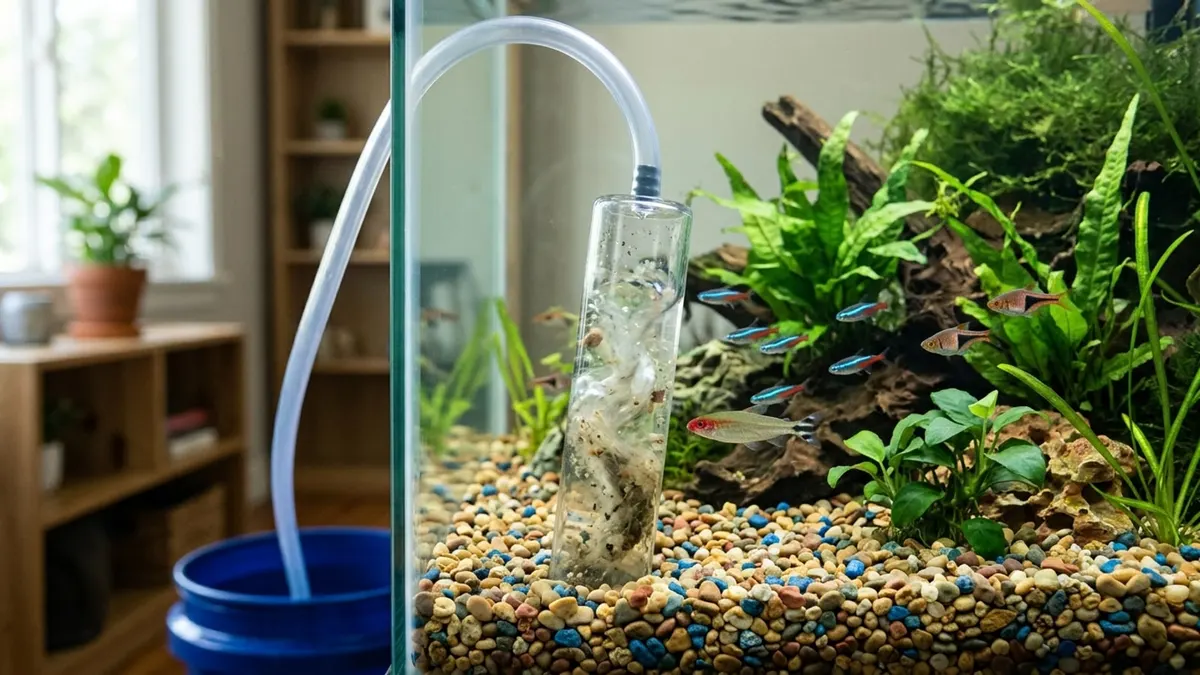
Cover image: Illustration: Aquarium Gear Review (AI-generated)
Related guides
API Freshwater Master Test Kit Review: Every Test, Step by Step
The API Freshwater Master Test Kit is still the kit to beat for freshwater tanks. Here is what each of its five tests measures, how to run them correctly, and its limits.
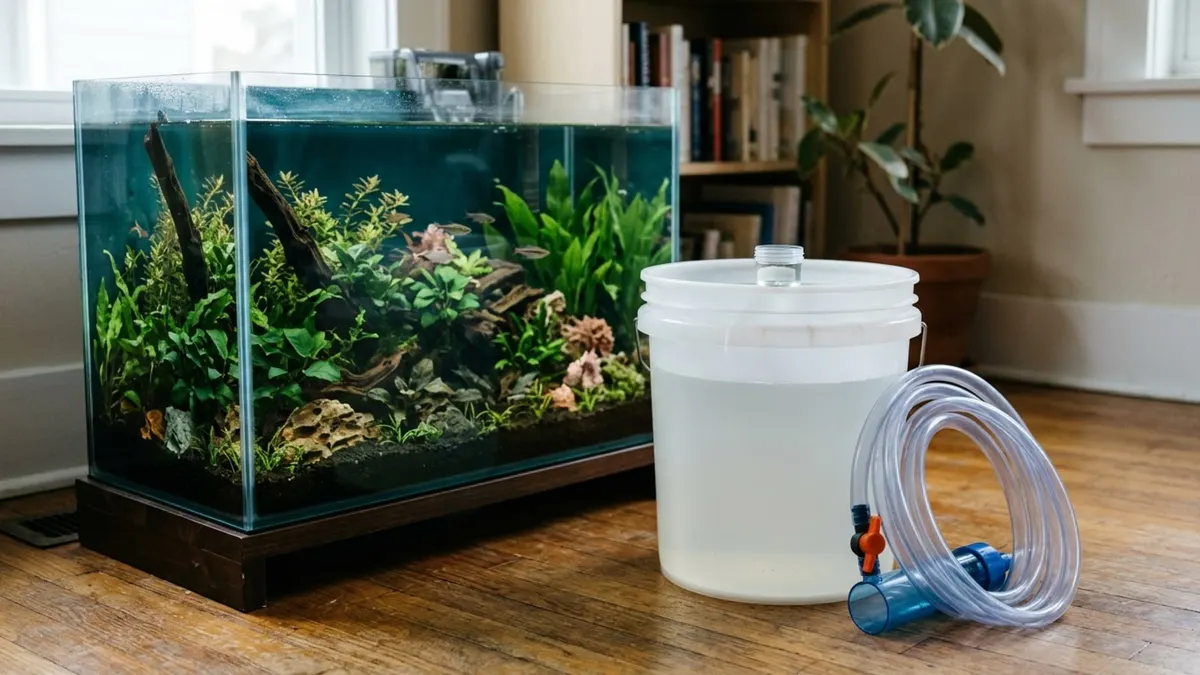
Best Aquarium Water Conditioners (2026): Doses and Claims Compared
Seachem Prime is the water conditioner we would buy: 5 mL treats 50 gallons, it handles chloramine, and Seachem states exactly what its ammonia binding does and does not do.
Best Aquarium Water Test Kits (2026): Liquid Kits vs Strips
API's Freshwater Master Test Kit is the one we would buy: ammonia, nitrite, nitrate and two pH ranges, over 800 tests. Here is when strips are enough and what reef tanks need.