
Betta Fish Water Temperature: The Right Range and How to Hold It
The right betta fish water temperature (76 to 81°F per a veterinarian), why room temperature is not enough, and how to hold a small tank steady all year.
Affiliate disclosure: product links on this page go to Amazon or to the maker's own store. As an Amazon Associate we earn from qualifying purchases, at no extra cost to you; links to makers' stores earn us nothing. No retailer or brand sees our picks before they are published or has any say in them. How we choose.
Keep a betta fish's water between 76 and 81°F (about 24 to 27°C), and aim for around 78°F. That is the range veterinarian Maria Zayas gives on PetMD, and it matches the 24 to 26°C recommended by Dr Rob Jones, an aquarium veterinarian writing for the RSPCA. Just as important as the number is keeping it steady: a small tank drifts with the room unless a heater holds it.
The range, in both units
| Water temperature | What it means for a betta |
|---|---|
| Below 72°F (22°C) | Too cold; outside both vets' ranges |
| 72 to 75°F (22 to 24°C) | Cool; below PetMD's 76°F floor |
| 76 to 78°F (24 to 26°C) | Inside both PetMD's and the RSPCA vet's ranges |
| 79 to 81°F (26 to 27°C) | Inside PetMD's range, above the RSPCA vet's |
| Above 81°F (27°C) | Warmer than either source recommends |
The overlap of the two veterinary sources is 76 to 78°F, which is exactly where preset betta heaters such as Fluval's P series (24 to 26°C) and Tetra's HT (78°F) hold the water. That makes 78°F the one number that satisfies both veterinary sources.
Why room temperature is not enough
Bettas are tropical fish. The RSPCA's vet warns that normal room temperature is usually too cold for them and fluctuates through the day. PetMD's care sheet recommends a heater even in a room that stays in range, specifically to prevent swings.
Small tanks make swings worse. A 2.5 or 5 gallon tank holds very little water, so it gains and loses heat quickly as the room warms in the afternoon and cools overnight. That is why PetMD gives 2.5 gallons as a minimum but calls 5 to 10 gallons ideal, and the RSPCA's vet suggests 20 liters (about 5 gallons) or more, with 10 liters as the absolute minimum. More water means steadier temperature.
How to hold the right temperature
Use a heater sized to the tank
PetMD suggests a heater of about 3 to 5 watts per gallon for a betta tank. In practice that means a 10 to 25 W heater for 2.5 to 5 gallons and 25 to 50 W for 5 to 10 gallons. Fluval rates its preset P10 for up to 3 gallons, its P25 for up to 6 and its P50 for up to 15, and adds that if the room is more than 12°F below 76 to 78°F you should use a higher-wattage heater. Our best betta heaters guide compares preset and adjustable models, and the heater size calculator works out wattage for your room.
Measure it
Keep a thermometer at the end of the tank away from the heater. A heater's dial or preset is a target, not a measurement. Check it daily for the first week and after any change, then every time you feed. A heater with a digital display helps, but a cheap separate thermometer catches a display that has drifted.
Put a lid on it
A lid holds heat and humidity in and keeps a betta from jumping out. Tetra notes its HT heaters are meant for tanks with hoods or glass canopies.
Match water-change water
When you change water (PetMD suggests 15 to 25 percent weekly; the RSPCA's vet says 10 to 25 percent), bring the new water close to the tank's temperature with your thermometer before you pour it in, and treat it with a water conditioner first. Cold tap water poured into a small tank drops the temperature fast.
What preset heaters hold
Preset heaters for small tanks are built around the same 78°F target. Here is what Tetra and Aqueon publish for their small presets:
| Heater | Wattage | Rated tank size | Preset | Status light |
|---|---|---|---|---|
| Tetra HT10 | 50 W | 2 to 10 gal | 78°F | Red when heating, green on standby |
| Tetra HT30 | 100 W | 10 to 30 gal | 78°F | Red when heating, green on standby |
| Aqueon preset | 50 W | Up to 20 gal | 78°F, accurate to 1°F either way | LED on while heating |
Both makers' presets sit inside PetMD's 76 to 81°F range and the RSPCA vet's 24 to 26°C. Aqueon's stated accuracy of 1 degree either way means a thermometer reading of 77 to 79°F is the heater working as designed, not a fault. A preset cannot be turned down and cannot cool, so on a hot day the steps in the next section are the only fix.
Wattage is the other thing to check. On a 2.5 gallon tank, a 50 W heater works out to 20 W per gallon, four to nearly seven times PetMD's guide of 3 to 5 W per gallon. The thermostat still holds 78°F, but if you want to follow PetMD's guide, choose a smaller heater for a tank that size.
When the water is too warm
In summer, a small tank in a sunny window or a hot room can run well above 81°F. Move it out of direct sun, take the lid off for an hour in the evening to let heat escape (watch for jumpers), and point a small aquarium fan across the surface. Fans cool by evaporation, so top the tank up with conditioned water. For tanks that stay hot, see the best aquarium chillers and cooling fans. Warm water also holds less oxygen, the USGS notes, so gentle surface movement from a sponge filter helps.
When the water is too cold
If the thermometer reads in the low 70s, check that the heater's lamp is on and that it is rated for the tank. Raise the temperature slowly rather than all at once; a sudden jump is a stress of its own. In a power cut, wrap the tank in a towel or blanket to slow heat loss, and keep the lid on. A battery air pump keeps oxygen moving if the filter stops.
Signs something is wrong
PetMD lists not eating, lethargy and abnormal swimming among its warning signs, and says to check water quality and temperature first when a betta seems unwell. A test kit for ammonia and nitrite and a thermometer reading rule out the two most common causes before you consider illness.
Quick checklist
- Tank of 5 gallons or more if you can (2.5 at the very least).
- Heater rated for the tank, preset at 76 to 78°F or set to about 78°F.
- Thermometer at the far end, checked daily at first.
- Lid on.
- New water temperature-matched and conditioned.
- Gentle filtration, such as a sponge filter, as PetMD recommends.
Setting up from scratch? Start with the best betta tanks.
Frequently asked questions
What temperature should a betta fish tank be?
Between 76 and 81°F, according to veterinarian Maria Zayas on PetMD, with about 78°F a good target. The RSPCA's aquarium vet gives 24 to 26°C, about 75 to 79°F.
Is 72 degrees too cold for a betta?
It is below the 76°F floor PetMD gives for bettas. A betta may survive it, but it is outside the recommended range, so add a heater rated for your tank.
Is 82 degrees too hot for a betta?
It is just above PetMD's 76 to 81°F range. Move the tank out of direct sun, add surface movement and a fan, and check that the heater is not stuck on.
Do bettas need a heater if the room is warm?
PetMD still recommends one, to stop the water swinging as the room warms and cools through the day. Small tanks change temperature quickly.
How do I warm up my betta tank safely?
Use a heater rated for the tank and let it bring the water up gradually. Avoid pouring in hot water, which changes the temperature suddenly and can stress the fish.
How do I check my betta tank temperature?
With an aquarium thermometer placed away from the heater. Read it daily for the first week and whenever you feed. Do not rely on the heater's dial alone.
Sources
- Betta Fish Care Sheet (Maria Zayas, DVM), PetMD
- How should I care for my Siamese fighting fish? (Dr Rob Jones), RSPCA Australia
- P Series Aquarium Heaters, Fluval
- Dissolved Oxygen and Water, U.S. Geological Survey
- HT Submersible Heaters, Tetra
- Preset Heaters, Aqueon
Cover photo: belaga, bojownik syjamski, cá lia thia, combatente, combattant, kampfisk, peixe de briga, petushok, sepilai, siamese fightingfish, siamese fighting fish, siamesischer kampffisch, siiami tapluskala, taistelukala, trey kroem phloek, петушок сиамский by Julien Lepage, CC BY 4.0, via inaturalist. Cropped.
Related guides
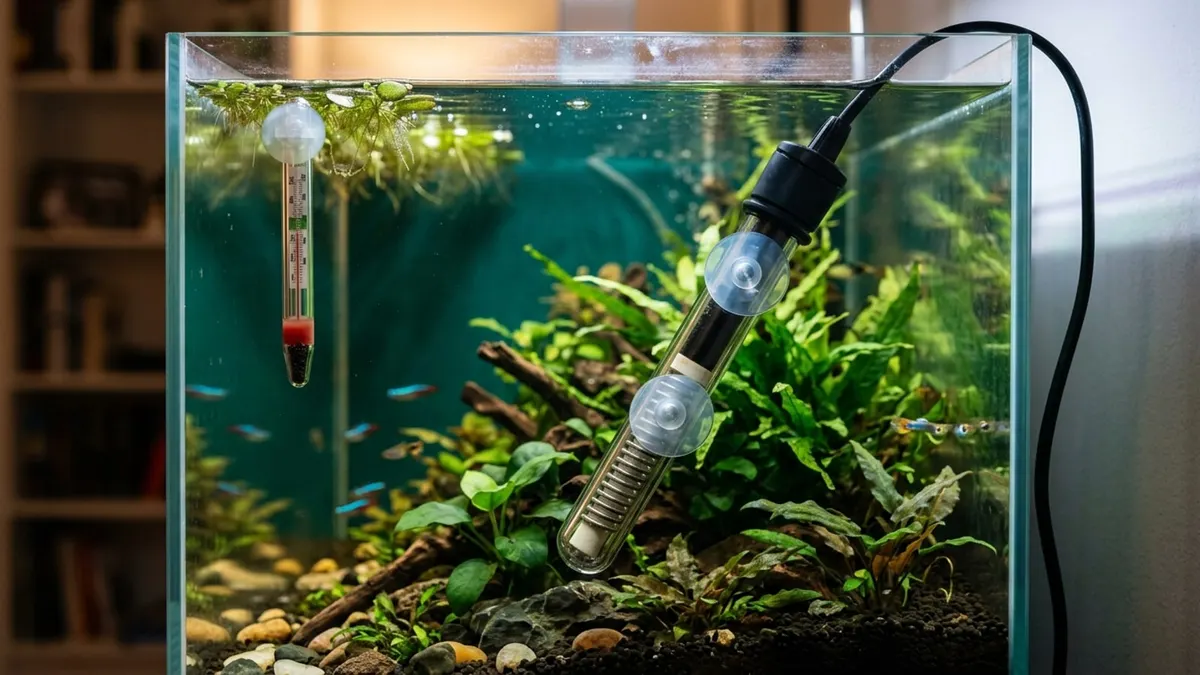
Aquarium Heater Size Calculator: Watts for Your Tank and Room
Enter your tank's volume and how warm the room is. The calculator gives a wattage from sera's watts-per-liter guide and the EHEIM heater size rated for that volume.
Best Aquarium Chillers and Cooling Fans for Hot Tanks and Axolotls
Active Aqua's 1/10 HP chiller is the one we would buy for a 20 to 40 gallon tank that runs hot. Here is when a fan is enough, how chillers are sized, and what axolotls need.
Best Aquarium Heaters (2026): Electronic, Titanium and Preset
Fluval's E200 is the heater we would put in a 40 to 55 gallon tank. Here is how it compares with EHEIM's thermocontrol e, a titanium heater with a controller, Inkbird's safety controller and a preset budget pick.