
RO Water for Aquariums: When You Need It and Which Unit to Buy
When an aquarium needs RO or RO/DI water, what reverse osmosis removes, the waste water it makes, and the RO units we would buy for reef and freshwater tanks.
Affiliate disclosure: product links on this page go to Amazon or to the maker's own store. As an Amazon Associate we earn from qualifying purchases, at no extra cost to you; links to makers' stores earn us nothing. No retailer or brand sees our picks before they are published or has any say in them. How we choose.
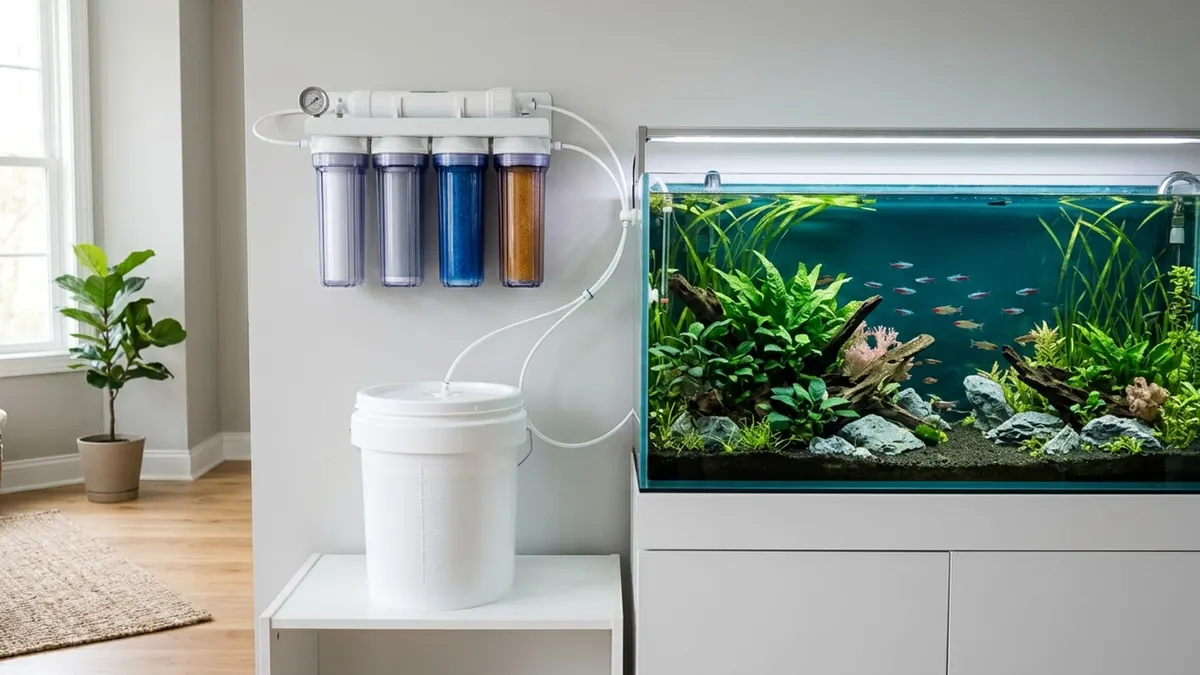
Use RO (reverse osmosis) or RO/DI water if you keep a reef tank, if your tap water carries nitrate, phosphate or high hardness that keeps feeding algae, or if you keep soft-water species that need very low mineral content. Most freshwater community tanks do fine on tap water treated with a conditioner. If you need RO, a 4-stage RO/DI unit such as the Aquatic Life RO Buddie makes water close to pure, and a deionization stage that changes color tells you when to replace it.
What reverse osmosis does
An RO system pushes tap water through a fine membrane that holds back most dissolved solids. Aquarium units add stages before and after it:
| Stage | What it removes |
|---|---|
| Sediment filter | Sand, silt and particles that would clog the rest |
| Carbon block | Chlorine and odors |
| RO membrane | Most total dissolved solids (TDS) |
| DI resin (RO/DI only) | The remaining TDS, for near-zero readings |
The EPA says point-of-use RO systems can reduce contaminants such as lead, volatile organic compounds and PFAS. For aquariums, the attraction is removing the dissolved nitrate, phosphate, silicate and minerals that tap water may carry into the tank.
The chloramine catch
Aquatic Life's own manual warns plainly that the RO Buddie removes chlorine but not chloramines, and tells buyers to ask their water company before installing it. If your utility uses chloramine (its annual water quality report says so), choose a unit with more carbon, such as LiquaGen's two-carbon design, and watch the DI stage's color. The EPA explains that many utilities use chloramines for longer-lasting disinfection.
Who needs RO water
- Reef tanks. Corals and the strong lights over them make tanks sensitive to nutrients from tap water. Red Sea's salt instructions tell keepers to mix its salt with RO water.
- Tanks fighting stubborn algae where tests show nitrate or phosphate in the tap water itself. API notes many tap supplies contain nitrate, which makes water changes less effective at lowering it.
- Soft-water species and shrimp that need low hardness.
- Saltwater top-off. Evaporation removes only fresh water, so top-off should be fresh, pure water; see auto top-off systems.
Most community fish, goldfish and livebearers do well on conditioned tap water. Test before you buy an RO unit.
The water it wastes
RO sends part of the water down the drain to flush the membrane. The EPA says a typical point-of-use RO system generates five gallons or more of reject water for each gallon of treated water, and some inefficient units produce up to 10. WaterSense-labeled drinking-water systems send 2.3 gallons or less per gallon treated. Aquarium units sit in that range: Aquatic Life's manual puts the RO Buddie's average rejection ratio at 1:3.5, so each gallon of pure water sends 3.5 gallons down the drain and 4.5 gallons pass through the unit in all. Many keepers reuse it for plants or cleaning.
Units we would buy
Aquatic Life RO Buddie 4-stage (50 GPD): best overall
Aquatic Life's listing describes a sediment filter, a carbon block, an RO membrane and a color-changing DI resin that turns from blue to tan when it needs replacing, rated at 50 gallons per day, with a 1-year limited warranty. It is compact and simple, and the color-change DI makes maintenance obvious. Its carbon will not handle chloramine, so pair it with extra carbon on chloraminated water.
LiquaGen 5-stage RO/DI (75 GPD): best for chloramine
LiquaGen's listing gives five stages: a 5 micron sediment filter, UDF activated carbon, coconut carbon, a 75 GPD membrane tested to ANSI Standard 58 for materials, and a deionization stage. The second carbon stage gives more protection where water is treated with chloramine.
Aquatic Life RO Buddie 3-stage (100 GPD): best RO without DI
The 3-stage RO Buddie skips the DI resin and makes up to 100 gallons per day, and its listing says it removes up to 98 percent of total dissolved solids. That is enough for many freshwater tanks and for topping off. Reef keepers usually want the DI stage for near-zero TDS.
Water pressure and temperature change RO output
An RO unit's gallons-per-day rating assumes ideal water. Aquatic Life rates the RO Buddie's membrane at 77°F (25°C) and 65 PSI, and its manual gives correction factors for anything else. Applied to a 50 GPD unit:
| Incoming water | Correction factor | Output of a 50 GPD unit |
|---|---|---|
| 50°F (10°C) | 0.58 | 29 gallons a day |
| 60°F (16°C) | 0.73 | 36.5 gallons a day |
| 70°F (21°C) | 0.87 | 43.5 gallons a day |
| 77°F (25°C) at 65 PSI | 1.00 | 50 gallons a day |
| 40 PSI | 0.67 | 33.5 gallons a day |
| 80 PSI | 1.33 | 66.5 gallons a day |
The manual sets the working range at 40 to 80 PSI: below 40 PSI the unit needs a booster pump, above 80 PSI a pressure regulator, and the membrane cannot take water hotter than 100°F. Aquatic Life also says to mount the RO Buddie upright, because running it on its side can raise the TDS of the output, not to run RO water through copper pipe (pure water leaches copper from it), and not to leave the unit running unattended.
Using RO water in a freshwater tank
Pure RO water has almost no minerals or buffering, and University of Florida extension scientists note that nitrifying bacteria need alkalinity, failing below 20 mg/L. So freshwater keepers usually remineralize RO water or blend it with tap water to the hardness their fish need. Test GH and KH with strips (see test kits) after blending.
Using RO water in a reef tank
Mix salt into RO/DI water following the salt maker's directions; Red Sea's say to use RO water at about 68°F, mix the salt in until dissolved, then raise the water to 77°F and check specific gravity with an accurate hydrometer or refractometer. Store mixed and fresh RO water in clean, food-grade containers.
Maintenance
RO cartridges wear out at a rate set by how much water passes through them and how much chlorine it carries. Aquatic Life gives these intervals for the RO Buddie:
| Stage | Aquatic Life's replacement interval |
|---|---|
| Sediment filter (5 micron) | 3 to 6 months; on average at every other carbon change |
| Carbon block | 3 to 6 months, or 1,500 gallons of tap water at 1 ppm chlorine |
| RO membrane | 1 to 2 years with regular filter changes |
| DI resin (4-stage unit only) | When all the resin has changed color |
The carbon block matters most, because chlorine that gets past a spent carbon stage damages the membrane. The manual says the carbon handles about 1,500 gallons of tap water at 1 ppm chlorine, which yields about 400 gallons of RO water, and only half that at 2 ppm. Flush a new membrane for 30 minutes and pour away that first water, as the manual directs, to clear the preservative it ships with. A TDS meter on the output shows when the membrane or DI is spent.
RO water does not need a water conditioner, because the carbon stage has already removed chlorine; tap water you blend with it still does. For reef equipment, see protein skimmers.
Frequently asked questions
Do I need RO water for my aquarium?
Usually only for reef tanks, soft-water species, or tanks where your tap water carries nitrate, phosphate or hardness that causes problems. Most freshwater community tanks do well on tap water treated with a conditioner.
Does RO water remove chloramine?
Not reliably with a single carbon block. Aquatic Life says the RO Buddie's carbon block will not remove chloramines. Choose a unit with extra carbon, such as LiquaGen's two-carbon design, if your water is chloraminated.
How much water does an RO system waste?
The EPA says a typical point-of-use RO system sends five gallons or more of reject water down the drain for each gallon treated, and inefficient units up to 10. Many keepers reuse the reject water for plants.
What is the difference between RO and RO/DI?
RO/DI adds a deionization resin after the membrane to remove the dissolved solids the membrane lets through, giving near-zero readings. Reef keepers usually want RO/DI; RO alone is enough for many freshwater uses.
Can fish live in pure RO water?
Not well without remineralizing. Pure RO water lacks minerals and buffering, and nitrifying bacteria need alkalinity. Freshwater keepers blend it with tap water or add minerals.
Should I use RO water for saltwater top-off?
Yes. Evaporation removes only fresh water, so top off with pure fresh water such as RO/DI, not salt water, to keep salinity steady.
Sources
- Point-of-Use Reverse Osmosis Systems, US EPA WaterSense
- Chloramines in Drinking Water, US EPA
- FA16 Ammonia in Aquatic Systems (Francis-Floyd, Watson, Petty and Pouder), University of Florida IFAS Extension
- Coral Pro Salt user guide, Red Sea
- Freshwater Master Test Kit instructions, API (Mars Fishcare)
- RO Buddie Series Installation, Operation and Maintenance Guide (models 540016, 540017, 540019), Aquatic Life
- 50 GPD 4-Stage RO Buddie Reverse Osmosis/Deionization System, Aquatic Life
Cover image: Illustration: Aquarium Gear Review (AI-generated)
Related guides
API Freshwater Master Test Kit Review: Every Test, Step by Step
The API Freshwater Master Test Kit is still the kit to beat for freshwater tanks. Here is what each of its five tests measures, how to run them correctly, and its limits.
Best Aquarium Gravel Vacuums and Water Changers (2026)
For tanks of 20 gallons and up, the Python No Spill Clean and Fill ends bucket carrying. For smaller tanks, Aqueon's bulb siphon is all you need. Here are both and an electric option.
Best Aquarium Water Conditioners (2026): Doses and Claims Compared
Seachem Prime is the water conditioner we would buy: 5 mL treats 50 gallons, it handles chloramine, and Seachem states exactly what its ammonia binding does and does not do.