
Best Aquarium Filters by Tank Size (2026): HOB, Canister and Sponge
The best aquarium filter for every tank size from 5 to 250 gallons, with the filter type that suits each tank and the makers' own flow and capacity figures.
Affiliate disclosure: product links on this page go to Amazon or to the maker's own store. As an Amazon Associate we earn from qualifying purchases, at no extra cost to you; links to makers' stores earn us nothing. No retailer or brand sees our picks before they are published or has any say in them. How we choose.
The best aquarium filter depends first on your tank's size and second on what lives in it. For most 10 to 30 gallon tanks we would buy the Fluval AC30, the current AquaClear hang-on-back filter. For 40 to 70 gallons, the Fluval 307 canister. For bettas, shrimp and fry at any size, a sponge filter on an air pump.
This page picks one filter for each common situation and links to the full guides for each type. Every capacity and flow figure is the maker's own (Fluval, Seachem, Hikari), and we say when a maker publishes real circulation as well as pump output.
Our top picks at a glance
1. Best for 10 to 30 gallons
Fluval AC30 (AquaClear) Power FilterType: Hang-on-back · Tank size: 10 to 30 gal (Fluval) · Flow: 150 GPH max · Best for: Most community tanks
2. Best for 30 to 55 gallons (no canister)
Seachem Tidal 55 Power FilterType: Hang-on-back · Tank size: up to 55 gal (Seachem) · Flow: 250 GPH max · Best for: 29 to 40 gal tanks
3. Best for 40 to 70 gallons
Fluval 307 Canister FilterType: Canister · Tank size: 40 to 70 gal (Fluval) · Flow: 206 GPH circulation · Best for: 55 gal tanks, planted and cichlid tanks
4. Best for 75 gallons and up
Fluval FX4 Canister FilterType: Canister · Tank size: up to 250 gal (Fluval) · Flow: 450 GPH circulation · Best for: Large tanks
5. Best for bettas, shrimp and fry
Hikari Bacto-Surge Sponge Filter, Small (up to 40 gal)Type: Sponge (air-driven) · Tank size: up to 40 gal (Hikari) · Flow: Set by the air pump · Best for: Betta, shrimp, fry, quarantine
| Pick | Type | Tank size | Flow | Best for | Buy |
|---|---|---|---|---|---|
| Fluval AC30 (AquaClear) Power FilterBest for 10 to 30 gallons | Hang-on-back | 10 to 30 gal (Fluval) | 150 GPH max | Most community tanks | Amazon |
| Seachem Tidal 55 Power FilterBest for 30 to 55 gallons (no canister) | Hang-on-back | up to 55 gal (Seachem) | 250 GPH max | 29 to 40 gal tanks | Amazon |
| Fluval 307 Canister FilterBest for 40 to 70 gallons | Canister | 40 to 70 gal (Fluval) | 206 GPH circulation | 55 gal tanks, planted and cichlid tanks | Amazon |
| Fluval FX4 Canister FilterBest for 75 gallons and up | Canister | up to 250 gal (Fluval) | 450 GPH circulation | Large tanks | Amazon |
| Hikari Bacto-Surge Sponge Filter, Small (up to 40 gal)Best for bettas, shrimp and fry | Sponge (air-driven) | up to 40 gal (Hikari) | Set by the air pump | Betta, shrimp, fry, quarantine | Amazon |
Best for 10 to 30 gallons
Fluval AC30 (AquaClear) Power Filter
The hang-on-back filter we would put on a 10, 20 or 29 gallon tank: big media box, adjustable flow, long warranty.
- Type
- Hang-on-back
- Tank size
- 10 to 30 gal (Fluval)
- Flow
- 150 GPH max
- Best for
- Most community tanks
Pros
- Fluval's refiltration keeps media working when flow is turned down
- 3-year warranty plus 2 years on registration
- Every part reachable from above the tank
Cons
- Needs a rim or lid cut-out to hang on
- Too small for a stocked 40 gallon
Fluval rates the AC30 for 10 to 30 gallons at up to 150 gallons per hour on 7 W. It ships with a foam block, carbon, BIOMAX ceramic media and an intake sponge. Its CycleGuard design lets you replace one of three media parts at a time, so you never throw out all the filter's bacteria at once.
For tanks from 5 to 20 gallons Fluval makes an AC20 (100 GPH), and for 20 to 50 gallons an AC50 (200 GPH). Our hang-on-back filter guide compares it with Seachem, Marineland, Tetra and Aqueon.
Best for 30 to 55 gallons (no canister)
Seachem Tidal 55 Power Filter
250 gallons per hour on 6 watts, for keepers who want to stay with a hang-on-back on a 40 gallon tank.
- Type
- Hang-on-back
- Tank size
- up to 55 gal (Seachem)
- Flow
- 250 GPH max
- Best for
- 29 to 40 gal tanks
Pros
- Built-in surface skimmer, per Seachem
- Self-priming pump and adjustable intake (per the listing)
- Low power draw
Cons
- 55 gallons is the top of Seachem's rating
- Bigger box sticks out further behind the tank
Seachem rates the Tidal 55 up to 55 gallons with a maximum flow of 250 gallons per hour on 6 W, a 1.2 liter filter volume and a built-in surface skimmer. It suits a 29 to 40 gallon tank especially well. On a full, busy 55, we would rather run a canister.
The Tidal 55 is one of four sizes. Seachem lists the Tidal 35 (up to 35 gallons, 130 GPH, 0.7 liters of media), the Tidal 75 (350 GPH, 1.9 liters) and the Tidal 110 (450 GPH, 3.2 liters), each with a self-priming pump. Its owner's manual says the flow dial can cut intake by up to 80 percent, and a refiltration grid then sends water back through the media for longer contact, so a turned-down Tidal keeps working its bio-media.
Best for 40 to 70 gallons
Fluval 307 Canister Filter
A canister with honest numbers: 303 GPH from the pump, 206 GPH of real circulation through the media.
- Type
- Canister
- Tank size
- 40 to 70 gal (Fluval)
- Flow
- 206 GPH circulation
- Best for
- 55 gal tanks, planted and cichlid tanks
Pros
- Fluval lists real circulation, not just pump output
- 7.3 L canister with 4.5 L of media chambers
- Quiet, and nothing hangs on the tank
Cons
- Hoses and a lid seal to look after
- Must sit below the tank
Above about 40 gallons, a canister's media volume and quiet running make it worth the extra setup. Fluval rates the 307 for 40 to 70 gallons, with a 303 GPH pump and 206 GPH of filter circulation, a 7.3 liter canister and a 5.75 foot maximum head. See the best canister filters for the 207, the FX4 and EHEIM's Classic.
Best for 75 gallons and up
Fluval FX4 Canister Filter
For 90, 125 and 180 gallon tanks, one FX4 replaces a pair of smaller filters.
- Type
- Canister
- Tank size
- up to 250 gal (Fluval)
- Flow
- 450 GPH circulation
- Best for
- Large tanks
Pros
- 700 GPH pump, 450 GPH real circulation
- 14 L canister
- 6.9 ft max head
Cons
- Large square footprint
- Overkill below about 75 gallons
Fluval rates the FX4 for tanks up to 250 gallons, with 450 gallons per hour of filter circulation and a 14 liter canister. On a 75 gallon tank, the 07 series 407 (rated 50 to 100 gallons) is a smaller, cheaper alternative.
Best for bettas, shrimp and fry
Hikari Bacto-Surge Sponge Filter, Small (up to 40 gal)
No impeller and no intake to trap a shrimp or a betta's fins, for less than the price of fish food.
- Type
- Sponge (air-driven)
- Tank size
- up to 40 gal (Hikari)
- Flow
- Set by the air pump
- Best for
- Betta, shrimp, fry, quarantine
Pros
- Gentle flow suits long-finned and small fish
- Excellent biological filtration for its cost
- Easy to keep a seeded spare
Cons
- Needs an air pump, sold separately
- Little chemical or fine mechanical filtration
Hikari rates the Bacto-Surge Small for tanks up to 40 gallons. An air pump drives water through the foam, where bacteria grow. For a betta in a 5 to 10 gallon tank or a shrimp colony, it is often the best filter there is. Our sponge filter guide covers sizes and pumps.
Hikari makes the Bacto-Surge in four sizes: Mini (up to 10 gallons), Small (up to 40), Large (up to 75) and X-Large (up to 125). Its directions say a new sponge needs at least 30 days of use to reach peak performance, so watch ammonia and nitrite in that first month. Hikari suggests a fresh sponge block every six months, soaked in the tank for at least two weeks before the swap so bacteria colonize it first.
Which filter type fits your tank
| Tank or livestock | Filter type | Why |
|---|---|---|
| Betta, shrimp, fry, quarantine | Sponge filter | Gentle flow, nothing to trap small animals |
| 5 to 30 gallon community tank | Hang-on-back | Cheap, easy to clean, plenty of media for the size |
| 30 to 55 gallons | Large HOB or canister | Either works; a canister is quieter and holds more |
| 55 gallons and up | Canister | Media volume and flow a HOB cannot match |
| Goldfish, large cichlids (messy fish) | Size up one model | More waste needs more media and flow |
| Reef tank | Sump or canister plus skimmer | See our protein skimmer guide |
What a filter actually does
A filter does three jobs. Mechanical filtration strains out debris with foam or floss. Biological filtration gives bacteria a surface to live on, and those bacteria are the most important part. University of Florida extension scientists describe the process: bacteria such as Nitrosomonas convert the ammonia fish excrete into nitrite, and others such as Nitrobacter and Nitrospira convert nitrite into nitrate, which is far less toxic. In a tank, they write, a biofilter must be provided as a place for those bacteria to live, and a new one takes six to eight weeks to build up. Chemical filtration (activated carbon and resins) removes odors, color and some dissolved compounds.
Our filter media guide explains what goes in each stage, and how to cycle a fish tank explains how to grow those bacteria before you add fish.
How we chose
- The maker's rated tank size, landing common tank sizes in the middle of the range rather than at the top.
- Flow figures we can trust. Fluval publishes both pump output and filter circulation for its canisters. Where only a maximum is given, we treat it as a ceiling.
- Media you can keep. Rinseable foam and ceramic media keep their bacteria; disposable cartridges throw some away at each change.
- Warranty and parts supply.
How much flow do you need?
There is no single right number, and makers already build their tank-size ratings around their own flow. The most useful rule is to buy a filter whose rated range puts your tank in the middle, then adjust for livestock: size up for goldfish and big cichlids, turn the flow down (or use a sponge) for bettas and planted tanks. Remember that rated flow is measured with no media. Fluval's own table shows its 307 circulating about two thirds of its pump output.
Filters and power cuts
When the power goes out, the bacteria in the filter start to run short of oxygen. Filters with self-priming pumps (Seachem Tidal, Aqueon QuietFlow) restart on their own when power returns; some hang-on-backs need refilling by hand. A battery air pump running a sponge filter keeps oxygen and a reserve of bacteria going through an outage. For a side-by-side look at the two main types, read canister vs hang-on-back filters.
Filter maintenance by type
Aquarium filter maintenance is mostly about cleaning out debris without throwing away the bacteria. Each maker below says how to do that for its own design.
| Filter | Maker's cleaning advice | What to avoid |
|---|---|---|
| Seachem Tidal 55 (HOB) | Clean when the maintenance alert rises about 1 cm above the cover; rinse the foam, then rinse the Matrix bio-media gently in a container of tank water | Soap or detergent, letting the bio-media dry out, replacing more than half of it at once |
| Fluval AC30 (HOB) | Replace one of its three media parts at a time (Fluval's CycleGuard design) | Changing all the media in one go |
| Hikari Bacto-Surge (sponge) | Rinse the sponge in water taken from the tank; replace the block every six months after a two-week soak in the tank | Tap or hot faucet water, which Hikari says can damage the sponge and its bacteria |
Unplug any filter before you work on it. Seachem's Tidal manual adds two electrical rules worth following with every brand: plug the pump into a circuit protected by a ground fault circuit interrupter (GFCI), and let the cord hang in a drip loop below the outlet so water running down it falls off before it reaches the plug.
What to skip
- The filter that came in a cheap kit, on a tank it was not rated for. Many kit filters are sized for the smallest tank in a range.
- Undergravel filters on new tanks. They work, but cleaning the gravel bed is awkward and they suit few modern setups.
- Changing all the media at once. It is the most common way to crash a tank's cycle.
Frequently asked questions
What is the best filter for a 20 gallon tank?
A hang-on-back filter rated to include 20 gallons. We would buy the Fluval AC30, rated by Fluval for 10 to 30 gallons at up to 150 gallons per hour. A sponge filter is the better choice if the tank holds a betta or shrimp.
Is a canister filter better than a hang-on-back filter?
For tanks over about 40 gallons, usually yes, because it holds more media and runs quieter. For smaller tanks a good hang-on-back is cheaper, easier to maintain and does the job.
Can a filter be too strong for a fish tank?
Yes, for bettas, fancy goldfish and small fish that struggle in current. Choose a filter with adjustable flow, aim the outflow at the glass, or use a sponge filter instead.
How long does a new filter take to work?
The mechanical part works at once, but the biological part needs bacteria to grow. University of Florida extension scientists put that at six to eight weeks for a new biofilter, which is why new tanks are cycled before fish go in.
Should a fish tank filter run all the time?
Yes. The bacteria living in the filter need a constant flow of oxygenated water. Switching a filter off for hours can kill them and cause an ammonia spike when it restarts.
Do I need a filter for a betta fish?
Yes. A betta still produces ammonia that has to be processed. A sponge filter on a small air pump, turned low, filters the water without the strong current bettas dislike.
Sources
- AC Series Aquarium Filters (Compare Models & Specs), Fluval
- 07 Series Aquarium Filters (Compare Models & Specs), Fluval
- FX Series Aquarium Filters (Compare Models & Specs), Fluval
- Compare Tidal Filters, Seachem
- Bacto-Surge Sponges, Hikari USA
- Tidal 55 - 75 - 110 Owner's Manual, Seachem
- FA16 Ammonia in Aquatic Systems (Francis-Floyd, Watson, Petty and Pouder), University of Florida IFAS Extension
Related guides
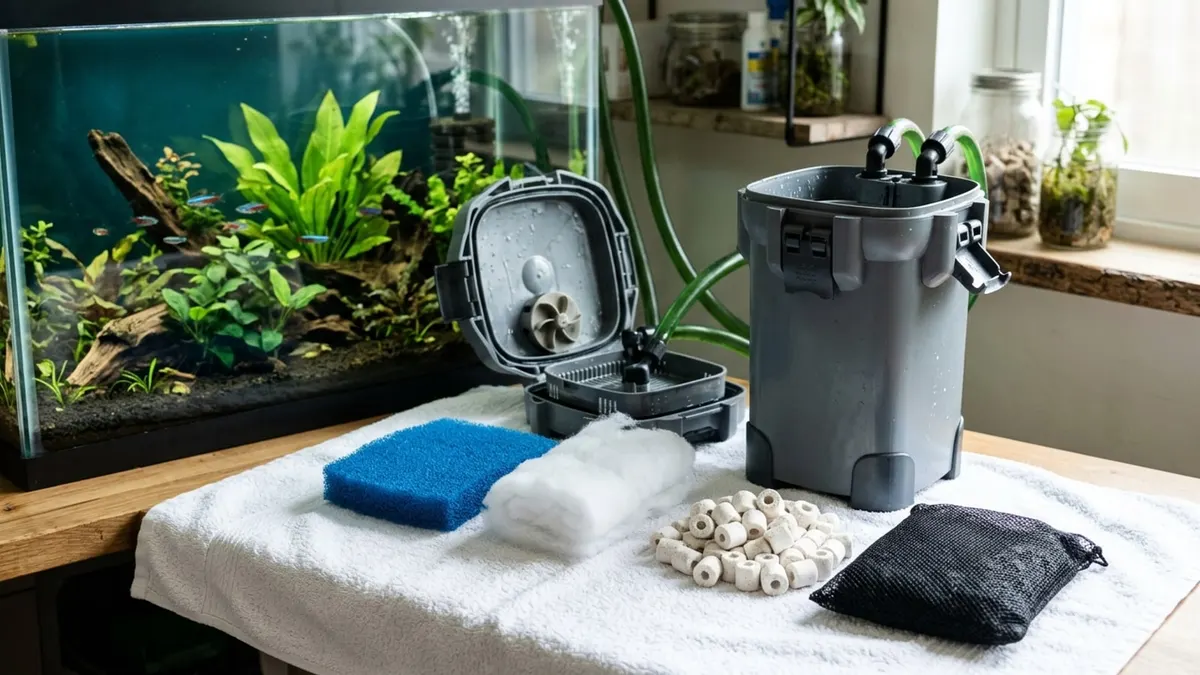
Aquarium Filter Media Explained: What Goes in Each Stage and in What Order
Sponge first, then biomedia, then floss or carbon if you want them. Here is what each kind of filter media does, the order it goes in, and what to rinse versus replace.
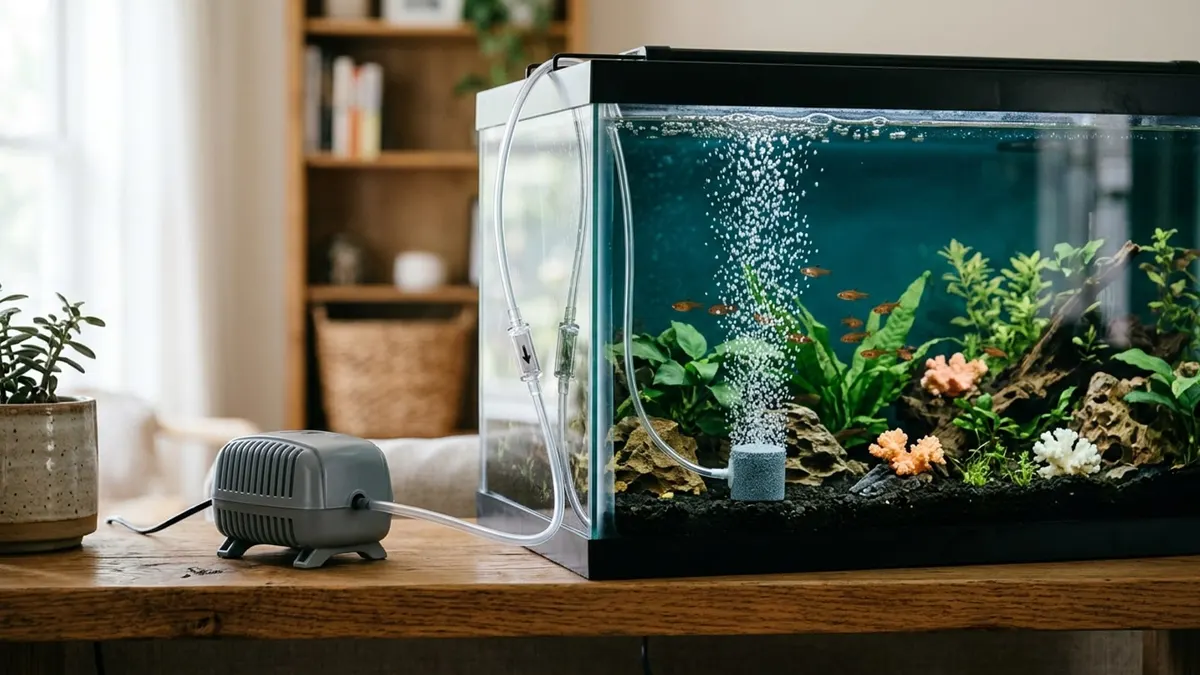
Best Aquarium Air Pumps: Quiet, Adjustable and Battery Backup
Tetra's Whisper is the air pump most tanks need. Here are the quiet, adjustable, nano and battery-backup alternatives, and how to size one to your tank and sponge filter.
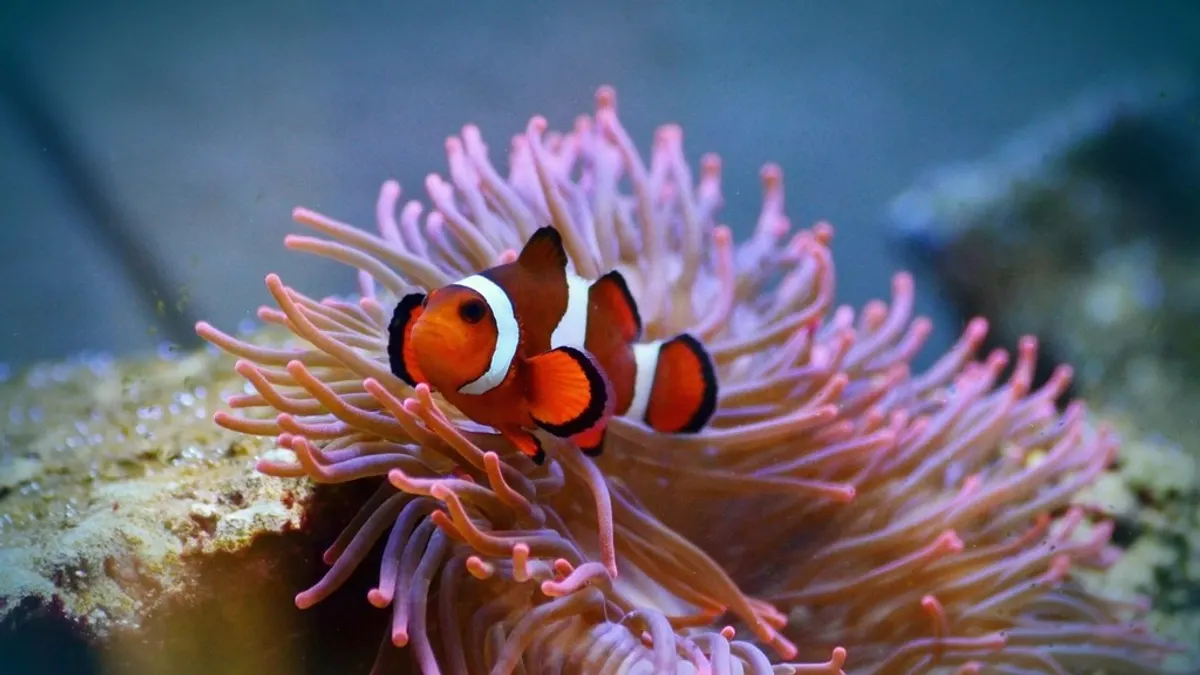
Best Aquarium UV Sterilizers for Green Water and Free-Floating Pests
Coralife's Turbo-Twist 3X is the UV sterilizer most tanks under 125 gallons should start with. Here is what UV does, what it does not, and which type fits your filter.