
Best Aquarium Chillers and Cooling Fans for Hot Tanks and Axolotls
The best aquarium chillers and cooling fans for reef tanks, axolotls and hot rooms, compared on horsepower, rated tank size, noise, what is included and setup.
Affiliate disclosure: product links on this page go to Amazon or to the maker's own store. As an Amazon Associate we earn from qualifying purchases, at no extra cost to you; links to makers' stores earn us nothing. No retailer or brand sees our picks before they are published or has any say in them. How we choose.
For a 10 to 40 gallon tank that runs too warm, the Active Aqua 1/10 HP chiller is the one we would buy. It has a titanium evaporator for fresh or salt water, a digital controller, and a boost mode for pulling the temperature down fast, and its listing rates it for 10 to 40 gallons. It runs inline on a canister filter's return or on its own pump.
Many tanks do not need a chiller at all. If the water is only 2 or 3 degrees too warm on summer afternoons, a clip-on cooling fan is a fraction of the price. Chillers earn their cost in hot rooms, on reef tanks under strong lights, and for cold-water animals such as axolotls, which the Ambystoma Genetic Stock Center keeps at 16 to 20°C (61 to 68°F).
Our top picks at a glance
1. Best overall (10 to 40 gallons)
Active Aqua 1/10 HP Chiller with BoostType: 1/10 HP refrigerated chiller · Rated for: 10 to 40 gal (per the listing) · Includes pump: No; fittings and remote included · Noise: Not listed
2. Best for reef tanks
JBJ Arctica Titanium Chiller, 1/10 HPType: 1/10 HP refrigerated chiller · Rated for: See JBJ's sizing chart · Includes pump: No · Noise: Listed as very quiet
3. Best complete kit
BAOSHISHAN 1/10 HP Aquarium Chiller (with pump and hose)Type: 1/10 HP refrigerated chiller · Rated for: 42 gal; 33 gal in peak summer (per the listing) · Includes pump: Yes, with tubing and clamps · Noise: 45 to 50 dB at 1 m (per the listing)
4. Best fan (auto on and off)
hygger Cooling Fan with Auto Temperature ControlType: Evaporative cooling fan · Rated for: Glass up to 1 in thick (per the listing) · Includes pump: Not needed · Noise: Listed as quieter than other fans
| Pick | Type | Rated for | Includes pump | Noise | Buy |
|---|---|---|---|---|---|
| Active Aqua 1/10 HP Chiller with BoostBest overall (10 to 40 gallons) | 1/10 HP refrigerated chiller | 10 to 40 gal (per the listing) | No; fittings and remote included | Not listed | Amazon |
| JBJ Arctica Titanium Chiller, 1/10 HPBest for reef tanks | 1/10 HP refrigerated chiller | See JBJ's sizing chart | No | Listed as very quiet | Amazon |
| BAOSHISHAN 1/10 HP Aquarium Chiller (with pump and hose)Best complete kit | 1/10 HP refrigerated chiller | 42 gal; 33 gal in peak summer (per the listing) | Yes, with tubing and clamps | 45 to 50 dB at 1 m (per the listing) | Amazon |
| hygger Cooling Fan with Auto Temperature ControlBest fan (auto on and off) | Evaporative cooling fan | Glass up to 1 in thick (per the listing) | Not needed | Listed as quieter than other fans | Amazon |
Best overall (10 to 40 gallons)
Active Aqua 1/10 HP Chiller with Boost
A compact refrigerated chiller with a titanium coil, digital control and a boost mode, from a brand sold widely for reef and hydroponic use.
- Type
- 1/10 HP refrigerated chiller
- Rated for
- 10 to 40 gal (per the listing)
- Includes pump
- No; fittings and remote included
- Noise
- Not listed
Pros
- Pure titanium evaporator for fresh or salt water (per the listing)
- Digital control holds a set temperature
- Boost function for faster cooling
Cons
- Stock is scarce on Amazon
- Needs a pump or canister return to push water through it; it also adds heat to the room it sits in
Active Aqua's 1/10 HP chiller is sold for small reef tanks, aquariums and hydroponic reservoirs. Its listing rates it for 10 to 40 gallons, describes a corrosion-resistant titanium evaporator for fresh or salt water, digital control and a boost mode, and says fittings and a remote come in the box.
Like every refrigerated chiller, it moves heat out of the water and into the room through its fan, so give it space to breathe and do not put it inside a closed cabinet. Plumb it on the return side of a canister filter or run it from a small pump, as the instructions direct.
Best for reef tanks
JBJ Arctica Titanium Chiller, 1/10 HP
A long-standing reef chiller with titanium coils and a two-year warranty, for keepers who want a known brand.
- Type
- 1/10 HP refrigerated chiller
- Rated for
- See JBJ's sizing chart
- Includes pump
- No
- Noise
- Listed as very quiet
Pros
- Titanium coils resist saltwater corrosion
- Uses R-134a refrigerant (per the listing)
- Two-year limited warranty (per the listing)
Cons
- Expensive and often scarce on Amazon
- The listing gives no tank rating; size it from JBJ's chart
JBJ's Arctica line has been a reef keeper's chiller for years. The 1/10 HP listing describes titanium coils, a highly efficient condenser and R-134a refrigerant, and gives a two-year limited warranty. A smaller 1/15 HP model suits nano reefs.
The listing does not give a gallon rating, so size it from JBJ's own chart and from how much heat your lights and pumps add. On a reef tank under strong LEDs in a warm room, it is a dependable choice; on a cool-room freshwater tank, it is more than you need.
Best complete kit
BAOSHISHAN 1/10 HP Aquarium Chiller (with pump and hose)
A 1/10 HP chiller that comes with a pump, tubing and clamps, with honest sizing advice in its listing.
- Type
- 1/10 HP refrigerated chiller
- Rated for
- 42 gal; 33 gal in peak summer (per the listing)
- Includes pump
- Yes, with tubing and clamps
- Noise
- 45 to 50 dB at 1 m (per the listing)
Pros
- Pump, tubing and hose clamps included
- Listing says it lowers water by up to 10°F
- Listing tells you to leave 6 in of clearance for the fans
Cons
- Seller's figures, not an established brand's spec sheet
- Up to 10°F of cooling may not be enough in a very hot room
BAOSHISHAN's listing is unusually frank about sizing: it rates this 1/10 HP chiller for 42 gallons but recommends 33 gallons in peak summer, says it can lower the water by up to 10°F to hold 68 to 78°F, and lists 45 to 50 dB at one meter. It comes with a stainless-shaft pump, tubing and clamps, and the listing says to leave 6 inches of clearance around the unit so its fans can shed heat.
For a 20 to 30 gallon axolotl tank or a small reef in a warm apartment, it is the easiest chiller to set up out of the box.
Best fan (auto on and off)
hygger Cooling Fan with Auto Temperature Control
A clip-on cooling fan with a temperature probe that switches itself on when the water passes your set point.
- Type
- Evaporative cooling fan
- Rated for
- Glass up to 1 in thick (per the listing)
- Includes pump
- Not needed
- Noise
- Listed as quieter than other fans
Pros
- Probe and controller start and stop it automatically between 68 and 93°F
- Three wind speeds
- Two-year warranty (per the listing)
Cons
- Cools by evaporation, so you must top up the tank more often
- Only takes off a few degrees; no help in a very hot room
A fan blowing across the water speeds evaporation, and evaporation carries heat away. hygger's fan clamps to tank walls up to 1 inch thick, has three speeds, and uses a probe and controller to switch on and off at a temperature you set between 68 and 93°F, according to its listing.
For a tank that creeps from 78 to 82°F on summer afternoons, that is often all you need. Expect to top the tank up with conditioned water more often, and use fresh water (not salt water) for top-off on a marine tank, since salt does not evaporate. An auto top-off handles that for you.
Fan or chiller?
| Cooling fan | Refrigerated chiller | |
|---|---|---|
| How it cools | Evaporation from the surface | Refrigeration, like a small fridge |
| How much | A few degrees | Holds a set temperature; BAOSHISHAN lists up to 10°F of cooling |
| Cost | Low | Several hundred dollars |
| Side effects | More evaporation to top up | Adds heat and noise to the room; needs a pump or filter return |
| Best for | Tropical tanks a little warm in summer | Axolotls, cold-water species, reefs in hot rooms |
Who needs a chiller
Axolotls
The Ambystoma Genetic Stock Center at the University of Kentucky, which supplies axolotls for research, houses its animals at 16 to 20°C (about 61 to 68°F) and says anything above about 22 to 23°C (72 to 73°F) is stressful, adding that axolotls are stressed more by heat than by cold. Most homes run warmer than that in summer, which is why "chiller for axolotl" is such a common search. Pair a chiller with a reliable test kit, since warm, stressed axolotls are also sensitive to ammonia.
Reef tanks
Strong reef lights, return pumps and wavemakers all add heat. A reef in a warm room can climb above the temperature its corals tolerate on summer afternoons. See our reef light guide; efficient LEDs add less heat than older lighting.
Tropical tanks in hot rooms
If your home has no air conditioning and summer rooms reach the high 80s, a fan alone will not hold a tropical tank in range. Warm water also holds less oxygen, the USGS notes, so add surface movement with an air pump during heat waves.
How we chose
- Rated tank size from the maker or the listing, and whether the listing is honest about summer performance.
- Titanium heat exchangers, which resist salt water.
- What is included: a pump, fittings, a controller.
- Noise and heat output, since a chiller lives in your room.
Sizing and setup
- Size for summer. Rated gallons assume normal conditions. BAOSHISHAN's own listing drops its rating from 42 to 33 gallons in peak summer; apply the same caution to any chiller.
- Give it air. A chiller dumps heat out of its fan. In a closed cabinet it heats the cabinet and struggles. BAOSHISHAN asks for 6 inches of clearance.
- Plumb it after the filter. Run it on a canister filter's return, or from a dedicated pump in a sump, so debris does not clog the coil.
- Do not fight the heater. If you run both, set the heater a couple of degrees below the chiller's set point so they never work against each other. A dual controller handles this.
- Cut heat at the source. Move the tank out of sun, run lights in the cooler hours, and keep the room cooler where you can.
What to skip
- Thermoelectric "chillers" for anything but tiny tanks. They cool far less than a compressor unit.
- Ice bottles as a routine. They cause temperature swings; use them only in an emergency.
- A chiller sized to the box rating in a hot room. Size up.
Frequently asked questions
Do I need a chiller for my aquarium?
Only if the tank regularly runs above the range your fish need. Most tropical tanks are fine with a fan in summer. Axolotls, cold-water species and reef tanks in hot rooms are the usual cases for a chiller.
What temperature do axolotls need?
The Ambystoma Genetic Stock Center houses its axolotls at 16 to 20°C (about 61 to 68°F) and says anything above about 22 to 23°C is stressful. Most homes are warmer than that in summer.
Will a fan cool my fish tank?
Yes, by a few degrees. A fan speeds evaporation from the surface, which carries heat away. You will need to top up with conditioned fresh water more often.
What size chiller do I need?
Start with the maker's rated gallons, then size up for a hot room, strong lights and pumps. BAOSHISHAN rates its 1/10 HP unit for 42 gallons but recommends 33 gallons in peak summer.
Where should an aquarium chiller go?
Outside the cabinet with space around it, plumbed on a canister filter's return or a pump line. A chiller pushes heat out of its fan, so a closed cabinet makes it work harder.
Can I run a heater and a chiller together?
Yes. Set the heater a couple of degrees below the chiller's set point so they never run against each other, or use a controller that manages both.
Sources
- Frequently Asked Questions, Ambystoma Genetic Stock Center, University of Kentucky
- Dissolved Oxygen and Water, U.S. Geological Survey
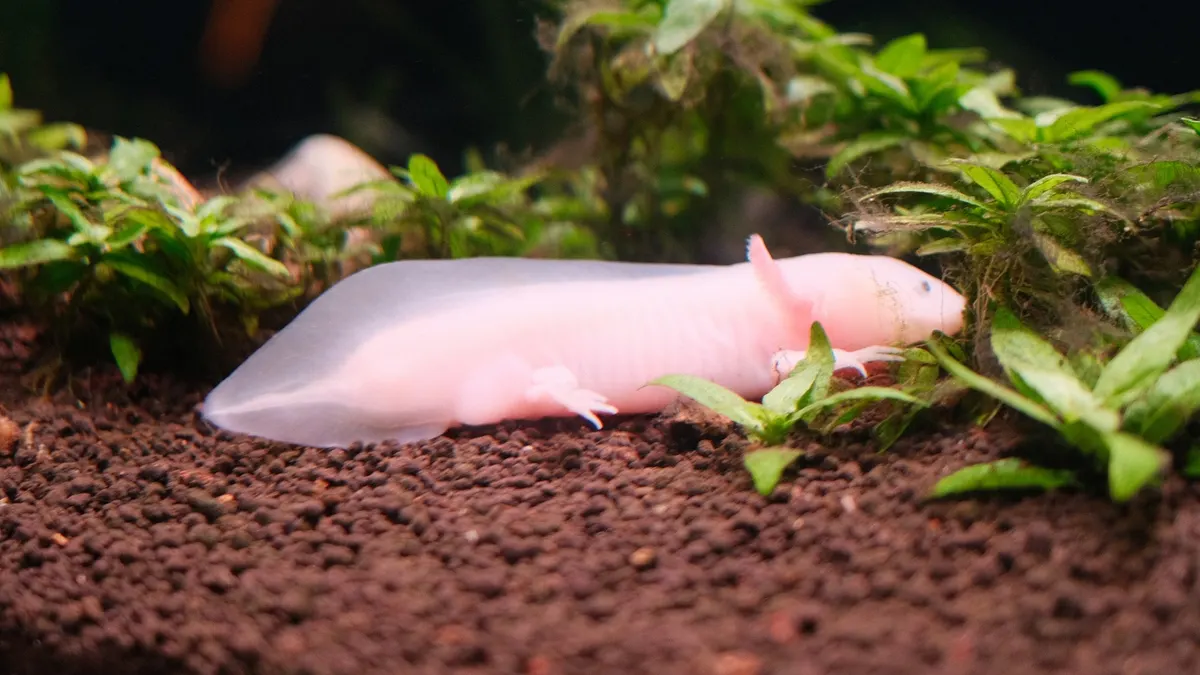
Cover photo: axolotl, salamandra ajolote by Bruno Peixoto, CC BY 4.0, via inaturalist. Cropped.
Related guides
Aquarium Heater Size Calculator: Watts for Your Tank and Room
Enter your tank's volume and how warm the room is. The calculator gives a wattage from sera's watts-per-liter guide and the EHEIM heater size rated for that volume.
Best Aquarium Heaters (2026): Electronic, Titanium and Preset
Fluval's E200 is the heater we would put in a 40 to 55 gallon tank. Here is how it compares with EHEIM's thermocontrol e, a titanium heater with a controller, Inkbird's safety controller and a preset budget pick.
Best Betta Fish Heaters for 2.5 to 10 Gallon Tanks (2026)
Tetra's 50 W HT holds a 5 to 10 gallon betta tank at 78°F with no dial to get wrong. Here are the adjustable, nano and shatterproof alternatives, sized to your tank.