
Canister vs Hang-On-Back Filter: Which Does Your Tank Need?
Canister vs hang-on-back aquarium filters compared on media volume, real flow, noise, maintenance, leak risk and cost, with the tank sizes where each one wins.
Affiliate disclosure: product links on this page go to Amazon or to the maker's own store. As an Amazon Associate we earn from qualifying purchases, at no extra cost to you; links to makers' stores earn us nothing. No retailer or brand sees our picks before they are published or has any say in them. How we choose.
For tanks under about 30 gallons, buy a hang-on-back filter: it is cheaper, simpler to clean and has nothing under the tank that can leak. For tanks over about 40 gallons, buy a canister: it holds several times more biological media, runs quieter, and leaves the back of the tank clear. Between 30 and 40 gallons either works, and the choice comes down to noise, looks and how much you want to spend.
Below is the side-by-side using two filters we rate highly for their size, Fluval's AC30 hang-on-back and its 307 canister, with every figure from Fluval's own spec pages.
Side by side
| Hang-on-back (Fluval AC30) | Canister (Fluval 307) | |
|---|---|---|
| Rated tank size | 10 to 30 US gal | 40 to 70 US gal |
| Flow | 150 GPH max | 303 GPH pump, 206 GPH circulation |
| Power | 7 W | 16 W |
| Media space | One foam, one carbon, one BIOMAX insert | 7.3 L canister, 4.5 L of chambers |
| Where it sits | On the rim, behind the tank | In the cabinet, hoses to the tank |
| Maintenance | Lift the lid, pull the media | Close valves, disconnect, open the lid |
| Leak risk | Low: overflows go into the tank | Hoses, valves and a lid seal to keep in order |
| Warranty | 3 years, plus 2 on registration | See Fluval's terms |
Media volume: the canister's biggest advantage
The most important thing a filter does is house the bacteria that convert ammonia and nitrite, and bacteria need surface. University of Florida extension scientists note that in a tank, a biological filter must be provided as a place where those bacteria can live. A canister is essentially a large media container. The 307 has 4.5 liters of chambers; a 30 gallon HOB holds a few hundred milliliters of each media type. On a heavily stocked tank, that difference is the margin between stable water and an ammonia spike. Our media guide explains how to fill either one.
Media volume in numbers
Media volume is where the canister vs hang-on-back gap is easiest to see. Seachem publishes the filter volume of each Tidal hang-on-back, and Fluval publishes the chamber volume of the 307:
| Filter | Type | Rated tank size | Media space (maker) |
|---|---|---|---|
| Seachem Tidal 35 | HOB | Up to 35 gal | 0.7 L |
| Seachem Tidal 55 | HOB | Up to 55 gal | 1.2 L |
| Seachem Tidal 75 | HOB | Up to 75 gal | 1.9 L |
| Seachem Tidal 110 | HOB | Up to 110 gal | 3.2 L |
| Fluval 307 | Canister | 40 to 70 gal | 4.5 L of chambers in a 7.3 L canister |
Seachem's largest hang-on-back, rated for 110 gallons, still holds less media than a Fluval canister rated for 70. On a big or crowded tank, that one comparison makes the case for the canister.
Flow: read the fine print
Makers rate both types with a clean filter and no media. Fluval is unusual in publishing the canister's filter circulation as well: the 307's pump makes 303 gallons per hour, but 206 gallons per hour actually passes through the media. A HOB's figure is also a best case; it drops as the foam fills with debris. Either way, choose a filter whose rated range puts your tank in the middle, not at the top.
Noise and looks
A HOB's water falls back into the tank from a lip, which makes a trickle, louder when the water level drops. A canister's return is under or at the surface, and its motor sits in a closed cabinet, so it is usually quieter. A canister also leaves the rim clear, which matters on rimless tanks and planted displays, and lets you hide the intake and outflow behind plants.
Space behind and below the tank
A hang-on-back filter needs room behind the tank, and a canister needs room under it. Seachem lists the wall clearance each Tidal needs: 2.75 inches for the Tidal 35, 3 inches for the 55, 3.5 inches for the 75 and 4 inches for the 110, so a tank pushed flat against the wall cannot take one. A canister needs floor space in the stand's cabinet instead, plus a route for two hoses up the back of the tank.
Maintenance and leaks
A HOB is the easier filter to live with. Every part is reachable from above, and if it overflows, the water goes into the tank. Seachem's Tidal even tells you when to clean it: a maintenance alert rises above the cover as the media basket clogs, and dripping from the side of the return means water is bypassing the media altogether. A canister needs more care: close the shut-off valves, disconnect, carry it to a sink or bucket, check the lid's O-ring, then re-prime it. Canisters must sit below the tank; above it they lose prime. In exchange, a canister holds more media (see the table above), so there is more room for debris before flow drops.
Power cuts and restarts
Hang-on-back and canister filters also differ in how they come back after an outage. Seachem says each Tidal has a self-priming pump that starts filtering as soon as it is plugged in on a filled tank, though its manual warns never to let the tank's water fall below the filter's minimum level mark, because the pump must not run dry. A canister holds its prime only while it sits below the tank with full hoses, so look for return flow after any outage.
Electrical safety for both types
Canister and hang-on-back filters both run a mains-powered pump beside a tank of water. Seachem's Tidal manual tells owners to connect the pump to a circuit protected by a ground fault circuit interrupter (GFCI), to loop the cord below the outlet so drips fall off before they reach the plug, and to unplug the filter before any maintenance. The same habits apply to a canister in the cabinet.
Cost
A HOB for a 20 gallon tank costs a fraction of a canister for a 55, and the canister also draws more power (Fluval lists 16 W for the 307 against 7 W for the AC30). On a big tank the canister is still the cheaper route than two or three HOBs.
What Seachem's filtration primer says
Seachem's primer on filtration, written by Leo G. Morin, PhD, puts the trade-off in two lines: the hang-on-back is an excellent mechanical filter, and the canister is the most efficient chemical filter and probably the best design overall. That matches the tank-size split above: a HOB for small, simple tanks, a canister once media capacity matters.
Who should buy which
| Your tank | Buy |
|---|---|
| 5 to 20 gallons | HOB (Fluval AC20 or AC30), or a sponge filter for bettas and shrimp |
| 20 to 30 gallons | HOB (Fluval AC30); a Fluval 207 canister if you want quiet and a clean rim |
| 30 to 40 gallons | Either: Seachem Tidal 55 HOB, or a Fluval 207 or 307 canister |
| 40 to 75 gallons | Canister (Fluval 307 or 407) |
| 75 gallons and up | Canister (Fluval FX4), or a sump |
| Rimless or planted display | Canister |
| First tank, small budget | HOB |
Both types can add a sponge filter as a backup, and both can be paired with an inline UV sterilizer, though a canister's return hose is the easier place to plumb one.
The full guides
- Best hang-on-back filters: Fluval AC30, Seachem Tidal 55, Marineland Penguin, Tetra Whisper IQ, Aqueon QuietFlow.
- Best canister filters: Fluval 307, 207 and FX4, EHEIM Classic 250, OASE BioMaster Thermo.
- Best aquarium filter by tank size, if you are still choosing the type.
Frequently asked questions
Is a canister filter better than a hang-on-back filter?
On tanks over about 40 gallons, usually: it holds much more biological media and runs quieter. On tanks under 30 gallons, a hang-on-back filter is cheaper and easier to clean and does the job well.
Can I use a canister filter on a 20 gallon tank?
Yes. Fluval rates its 107 for 10 to 30 gallons and its 207 for 20 to 45 gallons. It costs more than a hang-on-back but gives you a quiet filter and a clear rim.
Do canister filters leak?
They can if a hose comes loose, a valve is left open or the lid seal is damaged. Check the O-ring at each cleaning, keep hoses secure, and keep the canister below the tank in the cabinet.
Which is quieter, a canister or a hang-on-back filter?
Usually the canister, because its motor sits in a closed cabinet and its return is below or at the surface. A hang-on-back makes a trickling sound that grows louder when the water level drops.
Can I run a canister and a hang-on-back filter together?
Yes. Many keepers run both on large or heavily stocked tanks. Doubling up also means one filter keeps bacteria alive while you clean the other.
Sources
- AC Series Aquarium Filters (Compare Models & Specs), Fluval
- 07 Series Aquarium Filters (Compare Models & Specs), Fluval
- Compare Tidal Filters, Seachem
- Tidal 55 - 75 - 110 Owner's Manual, Seachem
- Basics of Aquarium Filtration (Leo G. Morin, PhD), Seachem
- FA16 Ammonia in Aquatic Systems (Francis-Floyd, Watson, Petty and Pouder), University of Florida IFAS Extension
Cover photo: Red sciaenochromis fish close up, CC0 1.0, via rawpixel. Cropped.
Related guides
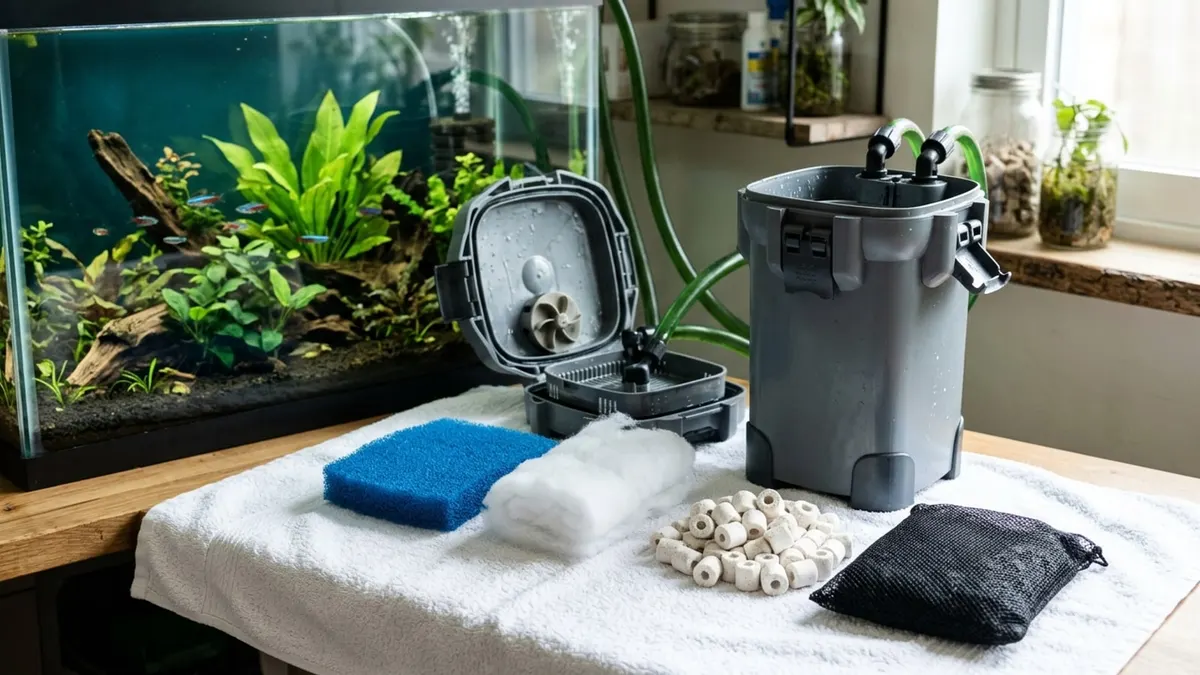
Aquarium Filter Media Explained: What Goes in Each Stage and in What Order
Sponge first, then biomedia, then floss or carbon if you want them. Here is what each kind of filter media does, the order it goes in, and what to rinse versus replace.
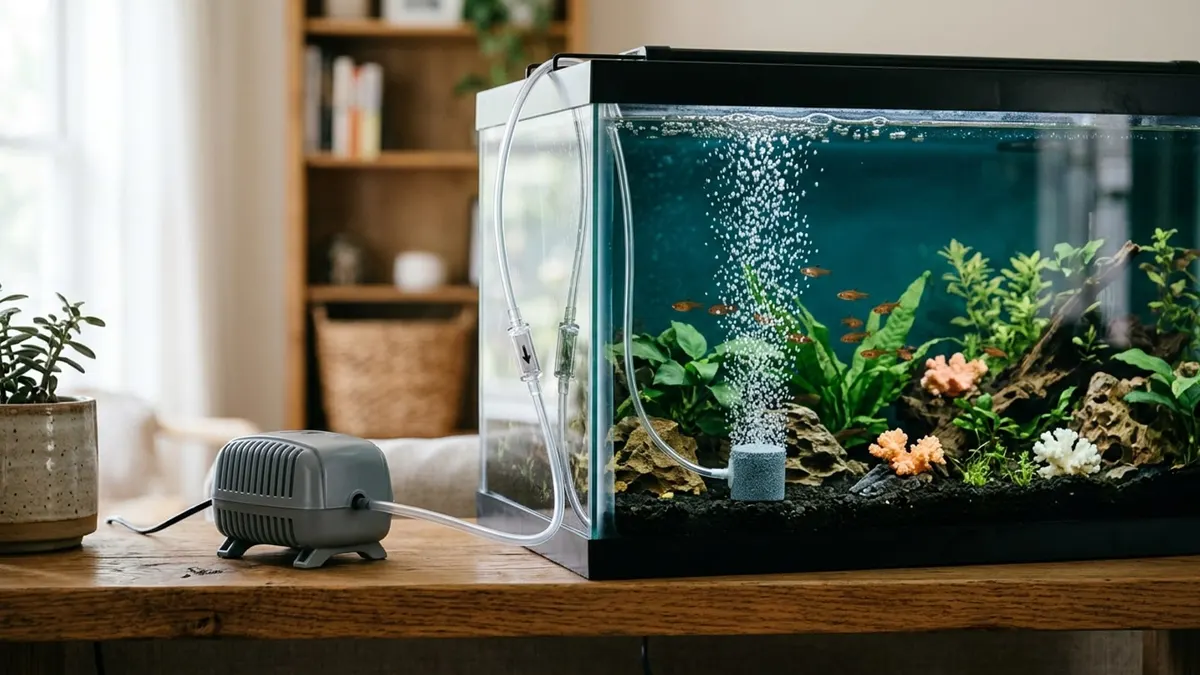
Best Aquarium Air Pumps: Quiet, Adjustable and Battery Backup
Tetra's Whisper is the air pump most tanks need. Here are the quiet, adjustable, nano and battery-backup alternatives, and how to size one to your tank and sponge filter.
Best Aquarium Filters by Tank Size (2026): HOB, Canister and Sponge
Which filter type fits your tank, and the one we would buy at each size: a sponge for bettas and shrimp, Fluval's AC30 up to 30 gallons, the 307 canister for 40 to 70, and the FX4 above that.