
Best Planted Tank Lights (2026): LEDs That Actually Grow Plants
The best planted aquarium lights compared on published PAR by depth, spectrum, length and control, from easy low-light tanks to dense carpeting plants.
Affiliate disclosure: product links on this page go to Amazon or to the maker's own store. As an Amazon Associate we earn from qualifying purchases, at no extra cost to you; links to makers' stores earn us nothing. No retailer or brand sees our picks before they are published or has any say in them. How we choose.
The Fluval Plant 3.0 is the planted tank light we would buy, in the length that fits your tank. It is built for plants (six LED colors, including 3000K, 6500K, 15000K, pink and two blues), it is app-controlled, and Fluval publishes PAR at 3, 6 and 12 inches: 442, 227 and 80 for the 22 W model. That last figure is what tells you whether light reaches your plants on the gravel, and few makers print it.
Plants need more light than fish, but more is not always better: light beyond what plants can use, without matching CO2 and fertilizer, grows algae. The picks below run from easy, low-light setups to bright tanks for carpeting plants.
Our top picks at a glance
1. Best overall (15 to 24 in tanks)
Fluval Plant 3.0 Bluetooth LED, 22 W (15 to 24 in)Fits: 15 to 24 in (Fluval) · Wattage: 22 W, 1,450 lumens · Published PAR: 442 at 3 in, 227 at 6 in, 80 at 12 in · Control: FluvalSmart app
2. Best for aquascapers
Chihiros WRGB II Slim 45 (45 to 60 cm)Fits: 45 to 60 cm (17.7 to 23.6 in) (per the listing) · Wattage: 1,800 lumens (per the listing) · Published PAR: Not in the listing · Control: My Chihiros app, RGB channels, 3000 to 13000K
3. Best automatic 24/7
Finnex Planted+ 24/7 HLC, 30 inFits: 30 in (per the listing) · Wattage: Not listed · Published PAR: Not in the listing · Control: 24/7 mode, remote, built-in sensor
4. Best budget (low-light plants)
NICREW ClassicLED Plus, 15 W (18 to 24 in)Fits: 18 to 24 in (per the listing) · Wattage: 15 W · Published PAR: Not in the listing · Control: Timer, 15 or 30 minute ramps
| Pick | Fits | Wattage | Published PAR | Control | Buy |
|---|---|---|---|---|---|
| Fluval Plant 3.0 Bluetooth LED, 22 W (15 to 24 in)Best overall (15 to 24 in tanks) | 15 to 24 in (Fluval) | 22 W, 1,450 lumens | 442 at 3 in, 227 at 6 in, 80 at 12 in | FluvalSmart app | Amazon |
| Chihiros WRGB II Slim 45 (45 to 60 cm)Best for aquascapers | 45 to 60 cm (17.7 to 23.6 in) (per the listing) | 1,800 lumens (per the listing) | Not in the listing | My Chihiros app, RGB channels, 3000 to 13000K | Amazon |
| Finnex Planted+ 24/7 HLC, 30 inBest automatic 24/7 | 30 in (per the listing) | Not listed | Not in the listing | 24/7 mode, remote, built-in sensor | Amazon |
| NICREW ClassicLED Plus, 15 W (18 to 24 in)Best budget (low-light plants) | 18 to 24 in (per the listing) | 15 W | Not in the listing | Timer, 15 or 30 minute ramps | Amazon |
Best overall (15 to 24 in tanks)
Fluval Plant 3.0 Bluetooth LED, 22 W (15 to 24 in)
A plant-specific spectrum with published PAR at depth, app scheduling and IP67 waterproofing.
- Fits
- 15 to 24 in (Fluval)
- Wattage
- 22 W, 1,450 lumens
- Published PAR
- 442 at 3 in, 227 at 6 in, 80 at 12 in
- Control
- FluvalSmart app
Pros
- 99 LEDs in six colors, chosen for plants
- PAR 80 at 12 inches, against 59 for Fluval's general AquaSky 18 W at the same depth
- IP67 waterproof; Fluval rates its lifetime at 50,000 hours
Cons
- Costs about double a general-purpose LED
- At full power it can outrun a tank without CO2; turn it down
The 22 W Plant 3.0 has 99 LEDs: 14 at 3000K, 55 at 6500K, 6 at 15000K, 6 pink, and 6 at 460 nm and 12 at 480 nm blue. Fluval lists 1,450 lumens and PAR of 442 at 3 inches, 227 at 6 inches and 80 at 12 inches below the fixture. On a 10 or 20 gallon tank, that puts real light on the bottom, where carpeting and red stem plants struggle under general lights.
Control is through the FluvalSmart app, which lets you dim the light and set a schedule. Without injected CO2, run it below full power: plants can only use as much light as their CO2 and nutrients allow. For 36 to 46 inch tanks (a 55 gallon), the 46 W Plant 3.0 delivers 112 PAR at 12 inches.
Best for aquascapers
Chihiros WRGB II Slim 45 (45 to 60 cm)
A Chihiros RGB panel tuned for low-to-medium energy planted tanks, with full color control in its app.
- Fits
- 45 to 60 cm (17.7 to 23.6 in) (per the listing)
- Wattage
- 1,800 lumens (per the listing)
- Published PAR
- Not in the listing
- Control
- My Chihiros app, RGB channels, 3000 to 13000K
Pros
- Individual red, green and blue channels through the app
- Chihiros says the Slim runs 40 to 50 percent less bright than the standard WRGB II, for low-to-medium energy tanks
- One-year warranty (per the listing)
Cons
- Priced well above most planted LEDs
- PAR figures are not in the listing
Chihiros lights are common over aquascaped tanks because of their red-heavy RGB color. The WRGB II Slim 45's listing gives an adjustable length of 45 to 60 cm, 1,800 lumens, a color temperature range of 3,000K to 13,000K, and per-channel control of red, green and blue in the My Chihiros app. It says the Slim is designed for low-to-medium energy setups. Chihiros's own product page puts it at 40 to 50 percent less bright than the standard WRGB II (the listing compares it with the PRO instead).
That makes it a good match for a planted tank without heavy CO2, where the full-power WRGB II would be too much light. Pick it for color and control; pick the Fluval if you want published depth figures.
Chihiros's page adds that the WRGB II Slim has a built-in controller, so it ramps sunrise and sunset and holds a set intensity for each color at each time point with no outlet timer. The Slim range covers tanks from 30 to 140 cm (11.8 to 55.1 inches) long, so a keeper moving from a 45 cm tank to a 4 foot one can stay with the same light family and app.
Best automatic 24/7
Finnex Planted+ 24/7 HLC, 30 in
A plant-capable bar with true 660 nm red, an automatic sunrise-to-moonlight cycle, a remote and a light sensor.
- Fits
- 30 in (per the listing)
- Wattage
- Not listed
- Published PAR
- Not in the listing
- Control
- 24/7 mode, remote, built-in sensor
Pros
- Four LED colors: green, red, blue and daylight (Finnex)
- Fully customizable sunrise and sunset
- Remote included
Cons
- 180-day warranty (per the listing) is short
- No published PAR
Finnex's Planted+ 24/7 HLC has a plant-oriented LED mix including true 660 nm deep red, according to its listing, with green, red, blue and daylight channels, a fully customizable sunrise and sunset, a remote and a built-in sensor. The 30 inch model fits a 20 long or 29 gallon tank.
It is a sensible choice for a low-tech planted tank of anubias, crypts, java fern and easy stems. Note the short 180-day warranty in its listing.
Finnex's own page describes the HLC's LEDs as four-chip clusters of 8,000K daylight, red, blue and green behind 120-degree optics, set in a single-cast aluminum hood that spreads heat. The infrared remote (with AAA batteries) handles programming, memory slots and weather modes, and Finnex says its 24/7 fixtures use Intertek-certified power supplies and two conformal coatings to keep moisture off the circuits.
Best budget (low-light plants)
NICREW ClassicLED Plus, 15 W (18 to 24 in)
A timer, a 660 nm red channel and sunrise ramps for low-light plants, at a fraction of the price.
- Fits
- 18 to 24 in (per the listing)
- Wattage
- 15 W
- Published PAR
- Not in the listing
- Control
- Timer, 15 or 30 minute ramps
Pros
- 6500K white, 450 nm blue, 660 nm red and green LEDs (per the listing)
- Listing says it suits low-medium light plants
- Built-in timer
Cons
- Not bright enough for carpeting plants
- NICREW recommends it over a glass or acrylic canopy
For a first planted tank of easy plants, NICREW's ClassicLED Plus has the essentials: a timer with 15 or 30 minute sunrise and sunset ramps and a spectrum with 660 nm deep red, according to the listing, which says it suits low to medium light plants. It costs far less than a dedicated planted light.
It will not grow a dense carpet in a 20 inch deep tank. Pair it with plants that tolerate modest light: anubias, java fern, cryptocorynes, java moss and floating plants.
How much light do plants need?
It depends on the plant, the depth and how much CO2 and fertilizer you add. A useful way to think about it is in three tiers, the same way Kessil's coverage guide separates "lightly planted" from "moderately planted" tanks:
| Tank style | Typical plants | Light | Extra needs |
|---|---|---|---|
| Low-tech | Anubias, java fern, crypts, mosses, floaters | A general or budget LED on a timer | Root tabs or a liquid fertilizer |
| Medium | Most stem plants, swords, some reds | A planted LED at partial power | Regular fertilizer; CO2 helps |
| High-tech | Carpets, demanding reds | A strong planted LED at high power | Injected CO2 and full fertilization |
Compare PAR at depth, not watts
Watts tell you power use, not plant light. PAR (photosynthetically active radiation) at the depth of your plants does. Fluval's published figures make the difference between a general light and a planted one plain:
| Fluval light | PAR at 3 in | PAR at 6 in | PAR at 12 in |
|---|---|---|---|
| AquaSky 2.0, 18 W (24 to 36 in) | 225 | 162 | 59 |
| Plant 3.0, 22 W (15 to 24 in) | 442 | 227 | 80 |
| Plant 3.0, 32 W (24 to 34 in) | 453 | 252 | 107 |
| Plant 3.0, 46 W (36 to 46 in) | 470 | 267 | 112 |
Measure from the light to the plants, not to the water surface: a light sitting on a 12 inch tall tank with 2 inches of gravel puts your carpet about 10 inches away.
Kessil's coverage by planting density
Kessil's coverage guide rates the same light for different planting densities, which shows how the usable footprint shrinks as plants get more demanding. Mounting heights are measured from the water surface, with a bare lens:
| Kessil light | Max power | Lightly planted | Moderately planted | Heavily planted |
|---|---|---|---|---|
| A80 or H80 | 15 W | 18 x 18 in, 6 to 8 in up | 12 x 12 in, 4 to 6 in up | Not listed |
| A160 or H160 | 40 W | 24 x 24 in, 8 to 10 in up | 18 x 18 in, 6 to 8 in up | Not listed |
| A360X | 90 W | Not listed | 24 x 24 in, 8 to 10 in up | 20 x 20 in, 6 to 8 in up |
Read it as a rule for any planted light: moving from easy plants to carpets and reds means a stronger fixture, a smaller area per fixture, or a lower mounting height. For freshwater, Kessil sells the A80, A160 and A360X in its Tuna Sun spectrum, which tunes from 6,000K to 9,000K.
How we chose
- Published output. Fluval's depth figures put it first.
- Spectrum. Red and blue LEDs alongside white, as plant growers favor.
- Dimming and scheduling. A planted light you cannot turn down is an algae light in a tank without CO2.
- Fit. Lengths for 10, 20, 29 and 55 gallon tanks.
Balance light, CO2 and nutrients
Plants grow only as fast as their scarcest input allows. Add lots of light without CO2 and nutrients, and algae take the surplus. Start your light at partial power with a fixed daily schedule, watch for a few weeks, and raise it only if plants are healthy and algae stays away. Test nitrate with a test kit; in a heavily planted tank it often runs low, not high.
Filters for planted tanks
Planted tanks want gentle, even flow and no surface splashing that drives off CO2. A canister filter with the outflow below the surface is the usual choice, or a sponge filter in small low-tech tanks. For general fish lights, see the best aquarium lights.
What to skip
- Buying the brightest light for a low-tech tank. It will grow algae faster than plants.
- Lights with no dimming. You will need to turn a planted light down at some point.
- Judging by wattage alone. Compare published PAR at your plants' depth.
Frequently asked questions
What is the best light for a planted aquarium?
One sized to your tank's length that publishes PAR at depth and can be dimmed. Fluval's Plant 3.0 is our pick: the 22 W model delivers 80 PAR at 12 inches below the light, against 59 for Fluval's general AquaSky 18 W.
How much PAR do aquarium plants need?
It varies with the plant and how much CO2 and fertilizer you add. Low-light plants such as anubias and java fern grow under modest light; carpeting plants need strong light at the substrate plus CO2. Compare lights by PAR at your plants' depth.
Can too much light hurt aquarium plants?
Too much light without enough CO2 and nutrients mainly grows algae, which smothers plants. Start a planted light at partial power and increase it only if plants stay healthy.
Do I need CO2 for a planted tank?
Not for low-light plants. Anubias, java fern, cryptocorynes and mosses grow without it. Dense carpets and demanding red plants usually need injected CO2 and strong light.
How far should a planted tank light be from the plants?
As far as it needs to be to deliver the right light at the substrate. Fluval's figures show PAR falling from 442 at 3 inches to 80 at 12 inches for the Plant 3.0 22 W, so deeper tanks need stronger lights.
Are RGB lights better for plants?
Red and blue light drive plant growth, and RGB lights let you add both. The bigger factor is total usable light (PAR) at the plants and a steady daily schedule.
Sources
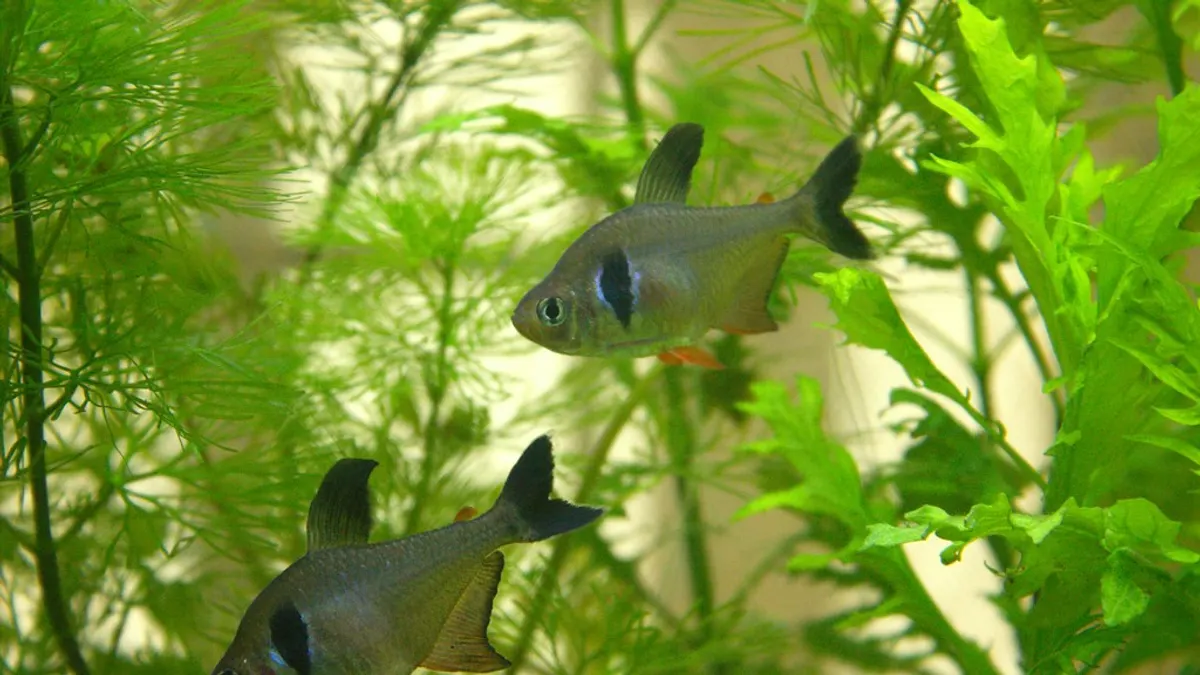
Cover photo: Fishes in planted aquarium by Hyderabadi Ladka, CC BY 2.0, via Flickr. Cropped.
Related guides
Best Aquarium Lights for Freshwater Tanks (2026)
Fluval's AquaSky 2.0 is the freshwater light we would buy for a 30 to 55 gallon tank. Here is how it compares with NICREW's ClassicLED Plus, hygger's 24/7 and Current's Satellite.
Best Reef Tank Lights for Corals (2026): Nano to 75 Gallons
Kessil's A160WE Tuna Blue is the reef light we would put over a 20 to 40 gallon reef. Here is how it compares with Red Sea's ReefLED G2, NICREW's HyperReef and a budget panel.
API Freshwater Master Test Kit Review: Every Test, Step by Step
The API Freshwater Master Test Kit is still the kit to beat for freshwater tanks. Here is what each of its five tests measures, how to run them correctly, and its limits.